EMAIL US:salesmanager@singi.com
- All
- Product Name
- Product Keyword
- Product Model
- Product Summary
- Product Description
- Multi Field Search


Views: 1 Author: Mark Zhang Publish Time: 2026-11-20 Origin: 本站
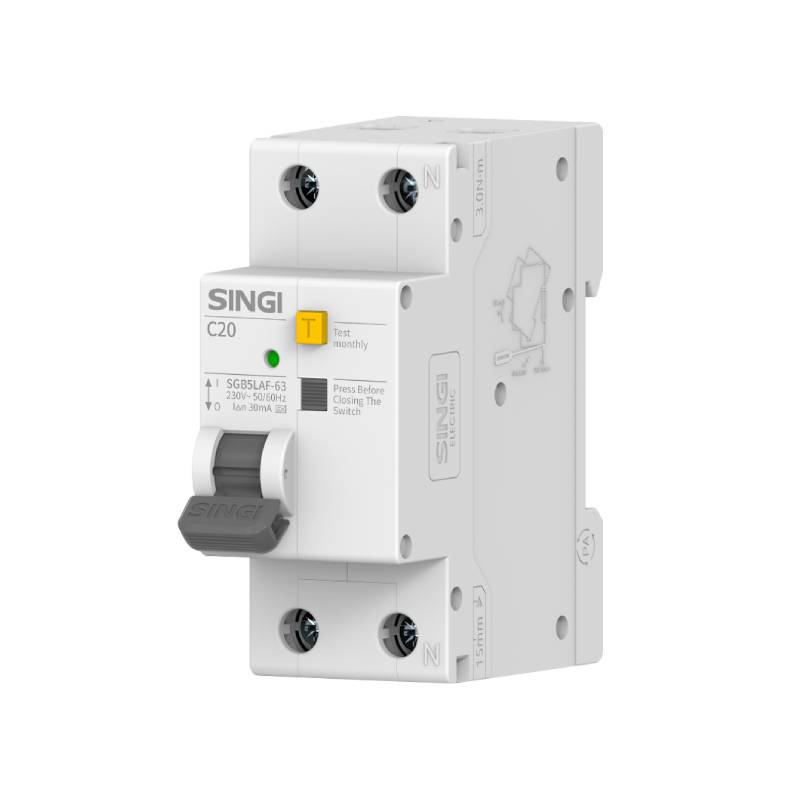
The SGB5LAF-63 AFDD Arc Fault Detection Device from SINGI is a DIN-rail protective device that adds arc fault detection to PV series distribution designs, catching the loose terminals, damaged insulation and degraded connectors that ordinary breakers ignore. Full specifications and the complete range are listed on the SINGI AFDD product page. This guide covers how arc fault detection works, where it fits in photovoltaic installations, and what engineers, distributors and procurement teams should verify before ordering from SINGI.
Table of Contents
Article Outline
An arc fault detection device monitors the amperage waveform on a protected circuit and disconnects the supply when it recognises the high-frequency signature of a sustained electric arc. Arcing is a normal event inside a switching contact for a few milliseconds. It becomes a fire risk when it persists at a poor connection: a terminal that was never torqued to specification, insulation nicked during installation, a connector that has corroded after years of thermal cycling, or cable crushed against a metal edge.
PV installations carry several conditions that make these faults more . Direct amperage side cabling runs long distances across rooftops and open ground. Connectors are mated in the field, in wind, dust and temperature extremes. Module-level electronics introduce high-frequency switching noise onto the same conductors, which complicates fault discrimination. Junction boxes and combiner enclosures are sealed and unmonitored.
A series arc on a PV string does not necessarily raise amperage above the rating of the string fuse or the breaker. It creates a local hot spot instead. That is the gap the SGB5LAF-63 AFDD Arc Fault Detection Device is designed to close, and it is the reason arc fault protection is now written into installation practice for buildings with sleeping accommodation and for higher-risk locations.
Miniature circuit breakers respond to amperage magnitude and duration. A 20 A breaker trips on a 100 A fault in milliseconds, and on a 25 A overload after a defined delay. A series arc drawing 4 A through a damaged joint sits comfortably below both thresholds. The circuit keeps working, the inverter keeps exporting, and the joint keeps heating.
Residual amperage devices cover a different failure mode. They compare live and neutral amperage and trip on earth leakage. A parallel arc to earth is detected if enough amperage flows to earth. A series arc inside a conductor, or a parallel arc between live and neutral, produces no imbalance and no residual amperage signal.
Fuses behave the same way. They protect against short-circuit current, not against the small, persistent arcing that develops at a degrading connection. Thermography finds these hot spots during an inspection, but inspections happen once or twice a year. An AFDD watches continuously.
Note for specifiers: arc fault protection complements overamperage and residual amperage protection. It does not replace either. A distribution board for a PV series installation needs all three functions, and the SGB5LAF-63 AFDD is chosen as the arc detection layer within that arrangement.
The SGB5LAF-63 from SINGI samples circuit amperage through a dedicated sensing element and analyses the waveform for the broadband, unstable pattern that distinguishes arcing from steady load current. Detection logic separates genuine arc signatures from the switching noise produced by inverters, variable speed drives and electronic loads, which is where nuisance tripping originates.
When a signature is confirmed, the device opens the circuit and latches into a fault state. A front-panel indicator shows the reason for the trip so maintenance staff can distinguish an arc fault from an overload or a manual disconnection. A test button allows a functional check during commissioning and periodic inspection without dismantling the board.
Mechanical and installation characteristics matter as much as the electronics in a real project:
Rated current, pole configuration, breaking capacity and tripping characteristics vary by variant. Confirm these values from the SINGI datasheet and the marking on the device before finalising a bill of materials.
The first decision is protection coverage. The table below shows which fault types each device class addresses, which helps engineering teams justify the extra pole space in a board schedule.
| Fault Type | MCB | RCD | SGB5LAF-63 AFDD |
|---|---|---|---|
| Overload and short circuit | Yes | No | Handled with the associated breaker in the same board |
| Earth leakage to ground | No | Yes | No, requires separate RCD protection |
| Series arc in a conductor or terminal | No | No | Yes |
| Parallel arc between live and neutral | Only above the magnetic trip threshold | Only where earth amperage flows | Yes |
| Continuous monitoring between inspections | Yes | Yes | Yes, with fault-type indication |
A second comparison helps during procurement, when several technical offers look similar on paper.
| Choice Point | What to Check | Why It Matters |
|---|---|---|
| Declared standard | Type test against IEC 62606 for AC AFDD performance | Confirms arc detection and immunity testing were carried out to a recognised method |
| Nuisance trip behaviour | Test data with inverter loads, harmonics and inrush | Reduces call-outs and unnecessary replacement of healthy devices |
| Fault indication | Separate indication for arc, overload and manual trip | Cuts diagnosis time on rooftop and remote installations |
| Board compatibility | Module width, busbar type, torque specification | Avoids rework during installation and keeps warranties intact |
| Documentation | Datasheet, declaration of conformity, test certificates | Required for project handover and inspection sign-off |
Arc fault detection performance is defined by IEC 62606:2013, the general requirements standard for AFDDs. It sets out how series and parallel arcing is simulated, the trip time limits, and the immunity tests that prevent a device from opening on normal load switching. A manufacturer claiming compliance should be able to produce type test evidence, not a catalogue statement.
On the direct amperage side of a photovoltaic system, UL 1699B:2018 defines the requirements for PV DC arc-fault circuit protection. The SGB5LAF-63 is applied to alternating amperage circuits within the PV series distribution arrangement, while dedicated DC arc fault protection belongs to the string and combiner level. Matching the device to the correct circuit side is the first check in any design review.
Nuisance tripping is the practical concern raised most by installers. Inverter start-up, grid switching and load steps generate amperage transients that resemble arc activity to a poorly tuned detector. Peer-reviewed work on low-volt-level arc fault detection, including Zhou, Li and Zhang's 2022 review in IEEE Transactions on Power Delivery, describes the discrimination problem in detail and confirms that detection algorithms must be validated against realistic load profiles than laboratory resistive loads alone. Ask for field experience data on inverter-fed circuits, and run a commissioning test on the installed load before the system is handed over.
Protective devices are ordered in volume and installed by crews working to a schedule. Consistency between batches, stable production, and clear documentation decide whether a project closes on time. SINGI supplies the SGB5LAF-63 AFDD Arc Fault Detection Device as part of a PV series portfolio that includes the breakers and accessories needed to complete a board from one source, which reduces the risk of incompatible components arriving on site.
Three points are worth confirming with any supplier:
For buyers comparing offers, the SINGI AFDD Arc Fault Detection Device family is documented on the AFDD category page, including the model range and application notes for PV series installations.
Arc faults develop, hide inside enclosures, and stay below the thresholds that conventional breakers watch. A device that monitors the amperage waveform for arc signatures closes that gap and turns a latent fire risk into a visible trip event. The SGB5LAF-63 AFDD Arc Fault Detection Device gives engineers a DIN-rail option for PV series boards, with fault indication that shortens diagnosis and a frame size suited to feeder positions. Full ratings, certificates and ordering information are available on the SINGI SGB5LAF-63 product page.
Q1. What does an AFDD do that a circuit breaker cannot?
A circuit breaker reacts to amperage magnitude. An AFDD analyses the amperage waveform and trips on the signature of a sustained arc, including series arcs that draw amperage well below the breaker rating.
Q2. Where is the SGB5LAF-63 AFDD installed in a PV system?
It is applied to the alternating amperage distribution circuits associated with a PV series installation, at the sub-main or feeder position where arc fault protection is required by the installation design.
Q3. Does an AFDD replace an RCD?
No. Arc fault detection, earth leakage protection and overamperage protection address different failure modes and are used together in a distribution board.
Q4. Why do some AFDDs trip without a real fault?
Inverter switching, motor drives and capacitive loads generate high-frequency noise that can be mistaken for arcing. Devices validated against realistic load profiles and tested to IEC 62606 immunity requirements reduce this risk.
Q5. What should be checked before ordering?
Rated current, pole configuration, breaking capacity, module width, board compatibility and the availability of test certificates. Confirm all values against the amperage datasheet for the exact variant.
Q6. Is arc fault protection required for photovoltaic installations?
Requirements vary by country and by building type. Local wiring regulations and the project specification decide the scope; the device choice follows from those requirements.
Ready to specify arc fault protection for a PV series project? Review the SGB5LAF-63 AFDD Arc Fault Detection Device specifications, request test documentation, or ask the SINGI technical team board layout and tripping behaviour. Visit the SINGI AFDD product page to compare models and place an enquiry.
[1] IEC 62606:2013. General requirements for arc fault detection devices (AFDDs) [S]. 2013.
[2] UL 1699B:2018. Photovoltaic (PV) DC Arc-Fault Circuit Protection [S]. 2018.
[3] Zhou L, Li H, Zhang X. Arc Fault Detection Technology in Low-Volt-level Distribution Systems: A Review [J]. IEEE Transactions on Power Delivery, 2022, 37(4): 2789-2801.