Arc faults on the AC side of a photovoltaic plant announce themselves. They burn through a terminal, trip a breaker, reset clean, and wait. This case study follows a mid-sized solar EPC and O&M contractor that replaced guesswork with circuit-level arc detection across 60 commercial rooftops using the SINGI SGB5LAF-63 AFDD.
Customer Background
The customer is a solar engineering, procurement, and construction contractor with an O&M division, founded 15 years ago and based in Valencia, Spain. The firm employs 210 people and manages roughly 380 MW of installed capacity, commercial and industrial rooftop systems between 100 kW and 2 MW, spread across Spain, Portugal, and southern France. Its O&M contracts cover 1,150 rooftops, including 240 sites where the original AC distribution boards date from 2011–2015.
Margins on O&M contracts are thin. Every unscheduled truck roll erodes them, and every insurance claim linked to electrical damage threatens the renewal terms the firm needs to keep bidding on larger portfolios.
What Was Causing Repeat Arc-Fault Trips on the Rooftop Fleet?
Between 2022 and 2024, the O&M desk logged 317 callouts it classified as "no fault found." An inverter had tripped, a sub-board breaker had opened, or a maintenance technician had arrived to a system running . The pattern was consistent: trips clustered in the late afternoon, when rooftop temperatures peaked and inverter output ramped down.
Three problems sat underneath those callouts.
- Loose AC terminations nobody could see. Thermal cycling on inverter AC feeds and sub-board lugs created series arcs inside enclosures. Standard miniature circuit breakers respond to overload and short circuit, not to a 12 A arc glowing inside a terminal block.
- Diagnosis by replacement. Technicians swapped breakers, tightened every screw in the board, and left. Fault localization averaged 4.2 hours per site, and roughly one in three sites tripped again within 90 days.
- Fire exposure on occupied buildings. Two scorched junction enclosures in 18 months, both on retail rooftops, triggered insurance scrutiny and a written improvement requirement from the firm's underwriter.
The direct cost was measurable: 317 callouts at an average of $410 each, close to $130,000 a year, plus the unmeasured cost of client complaints from tenants who lost power during trading hours.
Why Choose the SGB5LAF-63 AFDD?
The O&M director assessed four routes. Two European breaker brands offered AFDD ranges, but lead times ran 14 weeks and the modules were wider than the existing DIN rail space allowed in 2013-vintage boards. A sensor-plus-analytics platform was quoted at $3,900 per site with an annual subscription, and it flagged anomalies without ever telling a technician which circuit to open. The fourth option was a full board replacement, priced at $6,200 per rooftop and disruptive to tenants.
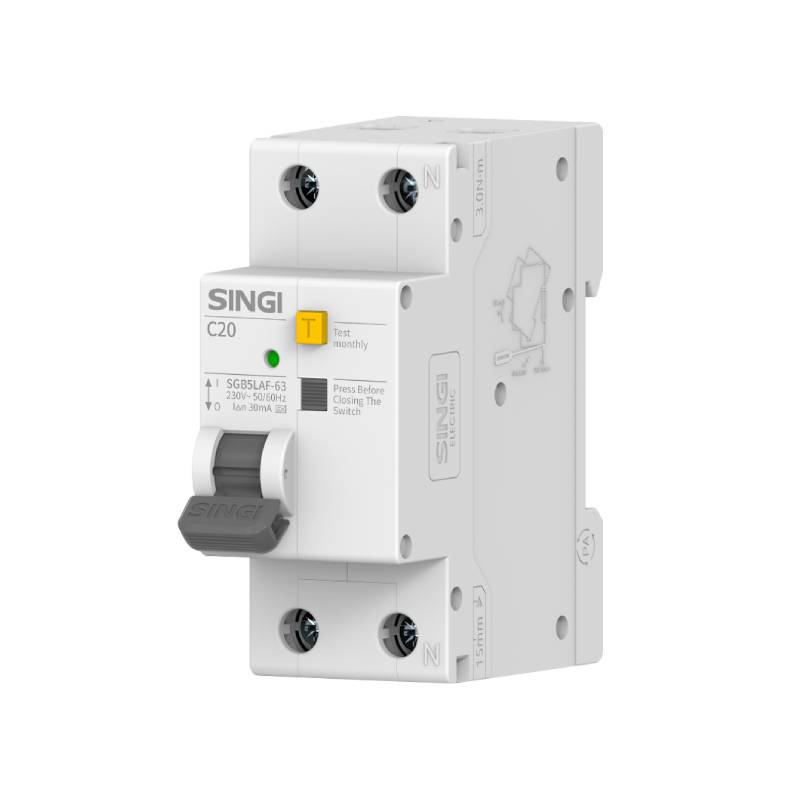
The SGB5LAF-63 AFDD from SINGI fit the retrofit constraint. Key decision factors:
- Combined protection in one module. Arc fault detection, overload, and short-circuit protection sit in a single DIN-rail device rated to 63 A, so the inverter AC feed and sub-board circuits could be protected without rebuilding the enclosure.
- Latching fault indication. The device flags an arc trip separately from an overload trip, so a technician opening the board knows what happened before touching a meter.
- IEC 62606 conformity. The underwriter's engineering team accepted the certification without requesting additional field validation, which shortened the approval cycle by roughly six weeks.
How Was the AFDD Deployed Across the Portfolio?
The rollout ran 14 months, from a pilot in April 2023 to portfolio completion in June 2024, structured in five steps.
- Circuit mapping. Engineers documented every AC circuit in 60 priority boards, separating inverter feeds, auxiliary loads, and tenant supplies. 14 boards were excluded after mapping showed aluminum wiring that needed replacement first.
- Eight-site pilot. SGB5LAF-63 devices went into the boards with the highest trip frequency over 10 weeks, alongside a log of every trip event and its cause.
- Neutral re-termination. The pilot exposed a wiring issue than a device issue (see below) and produced a standard work instruction for retrofit.
- Phased retrofit. Three crews covered 52 remaining sites in 12 months, averaging 90 minutes per board with no tenant downtime beyond a 15-minute isolation window.
- O&M integration. Trip data entered the maintenance platform, and the dispatch rule changed: an arc-flagged trip now sends a technician with a thermal camera, not a breaker kit.
The typical difficulty: shared neutrals in older boards
During the pilot, two sites produced repeated arc trips on healthy circuits. The cause was grouped neutral bars from the original 2012 installation, where several circuits shared a return path. Amperage flowing on a shared neutral produced a differential signal the AFDD read as an arc signature. The fix was mechanical, not electronic: each circuit received its own neutral termination, and a clamp meter check was added to the pre-installation survey. Nuisance trips on those two sites dropped to zero after re-termination, and the survey step became mandatory across the remaining portfolio.
What Quantifiable Results Did the Retrofit Deliver?
- 72% reduction in arc-related nuisance trips. Unplanned AC-side trips across the 60 sites fell from 284 in the 12 months before retrofit to 79 in the 12 months after.
- 63% fewer no-fault-found callouts. The count dropped from 317 to 118 annually, saving roughly $81,000 per year in labor and vehicle costs.
- Fault localization from 4.2 hours to 22 minutes. The latching arc indicator sends technicians to the correct circuit on the first visit.
- Zero arc-related fire incidents over 18 months, against two scorched enclosures in the preceding 18 months.
- 9% reduction in the electrical insurance premium after the underwriter reviewed 12 months of trip logs and the IEC 62606 certification file.
Total measured annual saving came to $148,000 across the 60 sites, against a retrofit cost of $96,000 in hardware and labor. Payback landed under eight months. Beyond the numbers, first-time-fix rates on electrical callouts rose from 61% to 89%, and two retail clients renewed O&M contracts with expanded scope.
What Did the Customer Say?
"For years we were sending people to buildings to tighten screws and hope," said the firm's Head of O&M. "The first month with the AFDDs told us more our AC boards than the previous five years of callout reports. The device does not stop every fault, but it stops the guessing, and that changed how we price O&M contracts."
What Can Other PV Operators Learn?
- Survey the neutral arrangement before ordering hardware. Shared neutrals in pre-2015 boards create false arc signatures. A clamp meter check costs minutes and prevents a false-trip complaint cycle.
- Pilot on the worst-performing boards, not the newest. The eight-site pilot used the highest-trip-frequency enclosures, which surfaced the wiring issue early and produced a work instruction that held up across 52 more sites.
- Feed trip data into dispatch rules. Detection without a changed maintenance workflow delivers a fraction of the value. Routing arc-flagged trips to thermal-camera inspections was worth more than the hardware upgrade alone.
Looking back, the O&M director would run the neutral survey across the entire portfolio before the first purchase order, not during the pilot. That sequencing alone would have compressed the rollout by roughly two months.
Industry Standards Referenced
- IEC 62606:2013 — General requirements for arc fault detection devices (AFDDs). Defines series and parallel arc detection, tripping performance, and immunity tests. webstore.iec.ch/publication/62606
- UL 1699B:2018 — Photovoltaic (PV) DC Arc-Fault Circuit Protection. Covers DC-side AFCI requirements and nuisance-trip performance for PV arrays. shopulstandards.com
- Zhou L, Li H, Zhang X. Arc Fault Detection Technology in Low-Volt-level Distribution Systems: A Review. IEEE Transactions on Power Delivery, 2022, 37(4): 2789–2801. ieeexplore.ieee.org