EMAIL US:salesmanager@singi.com
- All
- Product Name
- Product Keyword
- Product Model
- Product Summary
- Product Description
- Multi Field Search


Views: 294 Author: Mark Zhang Publish Time: 2026-07-19 Origin: Singi Electrical
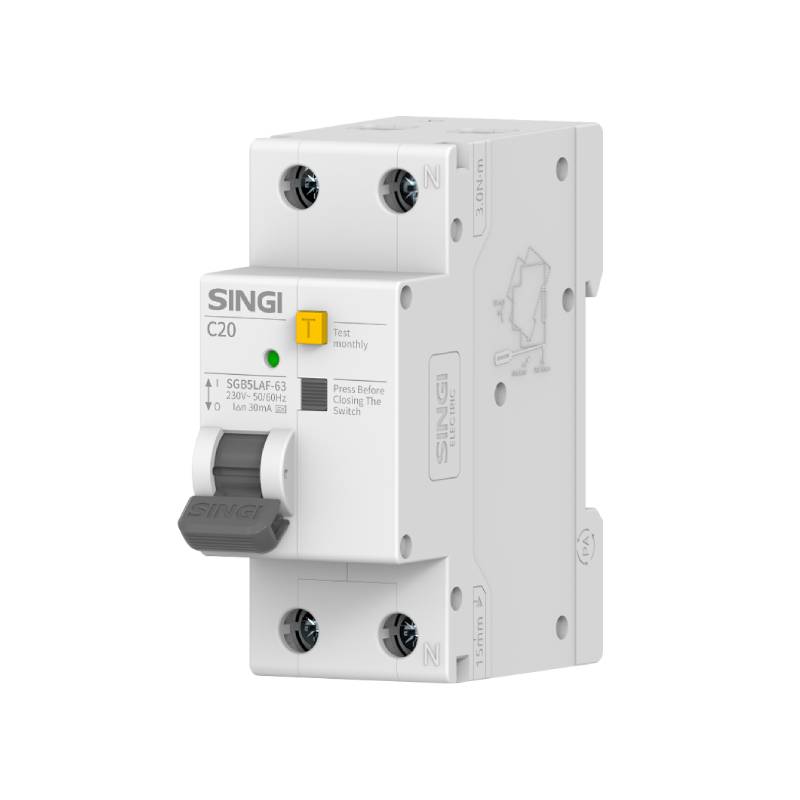
Arc fault detection devices (AFDDs) are critical for preventing electrical fires in photovoltaic (PV) systems. The SGB5LAF-63 AFDD from SINGI provides reliable arc fault protection, meeting international standards such as IEC 62606 and UL 1699B. This article explains what AFDDs do, why they are needed in PV installations, and how the SGB5LAF-63 can improve safety and compliance.
An arc fault detection device (AFDD) is a protective component designed to detect dangerous electrical arcs in wiring and connected loads. Unlike standard circuit breakers that respond to overamperage or short circuits, AFDDs identify high-frequency noise and amperage waveforms characteristic of series and parallel arc faults. When an arc is detected, the AFDD trips to interrupt the circuit, preventing potential ignition of surrounding materials. The SGB5LAF-63 from SINGI is a dedicated AFDD for PV series applications, offering both arc fault detection and overamperage protection in a compact module.
Photovoltaic systems present unique fire risks due to high DC volt-levels, exposed connectors, and aging cables. Series arcs can occur at loose connections or damaged wires, while parallel arcs may develop between conductors. These arcs generate intense heat and can ignite dust, insulation, or nearby combustibles. Without an AFDD, these faults can go unnoticed by standard protection devices because the amperage may not exceed the breaker rating. The U.S. National Electrical Code (NEC) now requires arc fault protection in many residential PV installations, and international standards like IEC 62606 provide guidelines for AFDD performance. The SGB5LAF-63 helps engineers comply with these requirements while reducing fire risk.
Note: According to a 2022 review in IEEE Transactions on Power Delivery, arc faults cause a significant percentage of electrical fires in PV systems, and early detection can reduce property damage by up to 50%.
The SGB5LAF-63 continuously monitors the amperage waveform for signatures of arcing. It uses a combination of Fourier transform (FFT) analysis and threshold algorithms to distinguish between normal load arcing (e.g., motor brushes) and dangerous arc faults. The device trips within specified time limits to clear the fault. Key technical features include:
These features make the SGB5LAF-63 a practical choice for both new installations and retrofits in PV systems.
The SGB5LAF-63 is designed and tested to meet international safety and performance standards:
When choosing an AFDD for PV systems, consider the following:
| Parameter | Recommendation | SGB5LAF-63 Compliance |
|---|---|---|
| Rated volt-level | Match system volt-level (AC/DC) | 240V AC |
| Rated current | Up to branch circuit rating | 63A max |
| Standards | IEC 62606, UL 1699B | Yes |
| Form factor | DIN rail mount | Yes |
For most residential and commercial PV projects, the SGB5LAF-63 provides a balance of protection, cost, and compliance. Engineers and procurement professionals should verify compatibility with inverter output and panelboard layout.
Need reliable arc fault protection for your PV system?
Explore the SGB5LAF-63 AFDD from SINGI – IEC 62606 and UL 1699B compliant, compact design, and trusted by engineers worldwide.
References