EMAIL US:salesmanager@singi.com
- All
- Product Name
- Product Keyword
- Product Model
- Product Summary
- Product Description
- Multi Field Search


Views: 10 Author: Mark Zhang Publish Time: 2026-11-26 Origin: 本站
A 180-employee metal stamping and fabrication plant in Ohio runs two shifts across 14 presses, six weld cells, and a 480 V distribution system. The plant produces brackets, housings, and reinforcement plates for automotive aftermarket and light industrial customers.
OEM customers shortened release windows and increased mix density. Changeovers rose from four per week to nine per week. Every minute of unplanned line stop moved the plant closer to missed delivery windows and premium freight charges.
Nine feeder breakers on the main stamping lines were 15 to 20 years old. On humid mornings and after press changeovers, one or more feeders would trip. Restart averaged 45 minutes because electricians had to locate the fault, reset the breaker, and verify press controls.
Breaker events consumed 9.6 production hours per month. At a $950 per hour contribution margin, the plant lost $9,120 in monthly output. Breaker maintenance added $21,000 per year in replacement parts, overtime, and emergency callouts.
The plant tried replacing fuses with adjustable breakers, raising trip settings, and adding cabinet fans. Higher settings reduced nuisance trips but left the coordination study out of date. Fans lowered cabinet temperature but did not correct aging thermal elements. The line still stopped with no clear electrical fault.
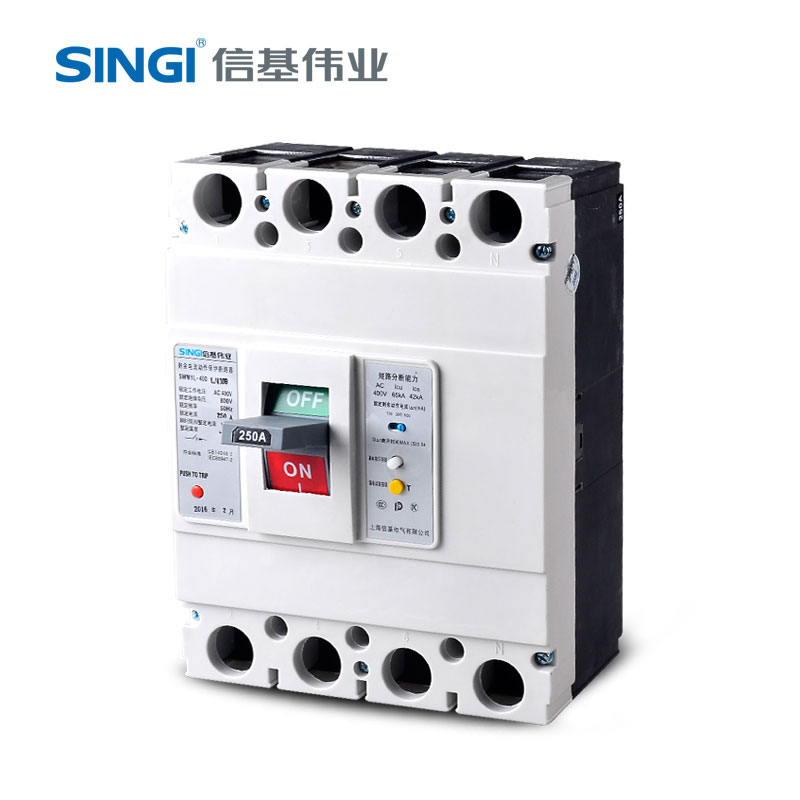
The maintenance team compared three options: rebuild the legacy breakers, buy a higher interrupting rating from another supplier, or retrofit with the SINGI SWM1L molded case circuit breaker.
Legacy rebuilds carried a 16-week lead time and no guaranteed trip curve match. The alternate supplier required a deeper panel and new lugs, adding $7,400 in enclosure work. The SWM1L offered a UL 489 listing, IEC 60947-2 compliance, a 25 kA short-circuit rating at 480 V, thermal-magnetic protection, and a compact frame that fit the existing panel depth.
Stock availability also mattered. The plant received six SWM1L units within five days, so the retrofit could follow the production schedule instead of waiting on a breaker order. More product details are available on the SWM1L product page.
The project ran six weeks from survey to final thermographic scan.
The main difficulty was busbar alignment. New breaker terminals sat 12 mm lower than the old stabs. Instead of cutting and rerouting every feeder, the team used listed offset adapter kits and re-drilled two mounting plates. Feeder lengths stayed intact, and the plant avoided a second shutdown.
On-time delivery moved from 91% to 96%. Weekend overtime for electrical repairs fell by $9,000 per year. The updated coordination study also brought arc flash labels in line with the new SWM1L trip settings.
“The line starts on the first push now. Electricians spend time on preventive work instead of emergency breaker swaps. The SWM1L trip curves have matched the loads since commissioning.”
If the plant repeated the project, the maintenance lead would order adapter kits with the breakers and schedule the thermal scan for a full production day than a weekend. That change would shorten the final verification step by two days.