EMAIL US:salesmanager@singi.com
- All
- Product Name
- Product Keyword
- Product Model
- Product Summary
- Product Description
- Multi Field Search


Views: 4 Author: Mark Zhang Publish Time: 2026-11-23 Origin: 本站
A 240-panel electrical retrofit inside a 1990s mixed-use complex shows what changes when the cover on a distribution board stops being an obstacle. Over 11 weeks, a property management group replaced warped, opaque panel covers with SINGI GNB50 flush mounted transparent covers across three office floors, a retail concourse and a two-level parking structure. The work finished without closing a single tenant suite, and the savings covered the project cost in under a year.
The operator manages a 26,000 m² mixed-use complex built in 1994: 180 tenant suites, a ground-floor retail concourse, three office floors and an underground parking deck. An in-house electrical team of six licensed technicians handles all maintenance, inspection and after-hours response.
The building holds 240 distribution boards, split between tenant sub-boards on each floor and common-area panels in risers, plant rooms and the parking structure. Three pressures shaped the project: tenants reviewing service charges line by line, an insurer tightening documentation requirements for electrical inspection records, and a maintenance team that shrank from nine technicians to six over four years while the panel count stayed flat.
Every scheduled inspection started the same way: four screws out, cover lowered to the floor, breaker positions checked, cover lifted back and refitted. The average board took 16 minutes. With quarterly inspections across 240 boards, that loop ran 960 times a year and consumed a large share of the team's available hours.
Three problems followed from that routine.
The cost of doing nothing was visible in three lines: technician hours, after-hours call-outs at a four-hour minimum-val, and replacement covers at roughly $42 each.
The team shortlisted three routes and costed each one.
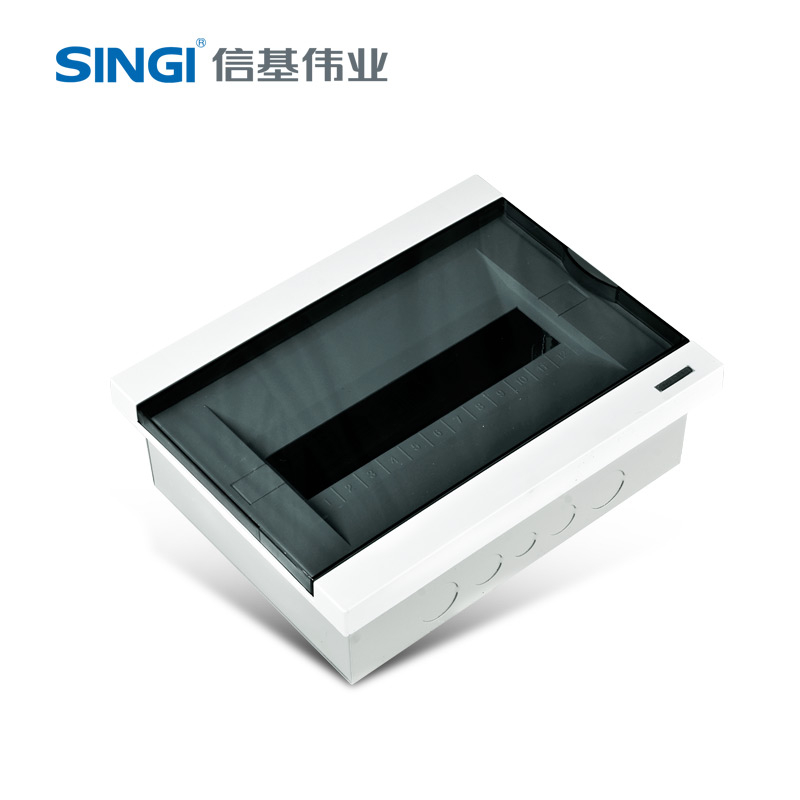
The SINGI GNB50 flush mounted transparent cover addressed all three failure points at once. The bezel sits close to the finished wall, so corridor projection dropped to a few millimetres and the egress objection disappeared. The transparent cover lets a technician read breaker positions, trip flags and the printed circuit schedule from the corridor without removing anything. A quarter-turn tool latch keeps tenants out while giving staff access in seconds, and the gasket seal keeps dust out of the enclosure.
Standard 50-size footprints matched the existing cut-outs on most of the building, which kept wall work to a minimum-val. Unit cost landed between $38 and $46 depending on configuration, a fraction of a new enclosure.
Planning started in April and the last panel was signed off in July, an 11-week window that included survey, mock-up, installation and audit.
The one real obstacle was wall depth. The 1994 block uses shallow cavities that would not accept a standard interior alongside the cabling. The solution was a shallow DIN interior on the 40 thin-cavity panels, plus a surface-mounted configuration on the concrete parking walls where corridor clearance was never an issue.
Total project cost came to $21,400 including labor, wall patching and labeling. Payback landed at roughly 11 months against the labor and replacement savings alone, before counting the reduction in emergency call-outs.
"An inspection used to be a two-person job with a screwdriver and somebody holding a torch," said the electrical supervisor for the complex. "Now one technician walks the riser with a tablet and reads the panel through the cover. The part nobody expected was the tenant calls — being able to talk someone through a tripped breaker over the phone took a lot of night work off the schedule."
Asked what the team would change, the supervisor pointed to labeling. The QR codes were added in the final phase; rolling them out at the start would have shortened the audit by two weeks.
Enclosure choice and protection coordination for low-volt-level boards sit inside a well-documented framework. The references below informed the specification and inspection regime used on this project.
Full specifications for the SINGI GNB50 flush mounted transparent cover are available at https://www.singi.com/92.html.