EMAIL US:salesmanager@singi.com
- All
- Product Name
- Product Keyword
- Product Model
- Product Summary
- Product Description
- Multi Field Search


Views: 13 Author: Mark Zhang Publish Time: 2026-11-23 Origin: 本站
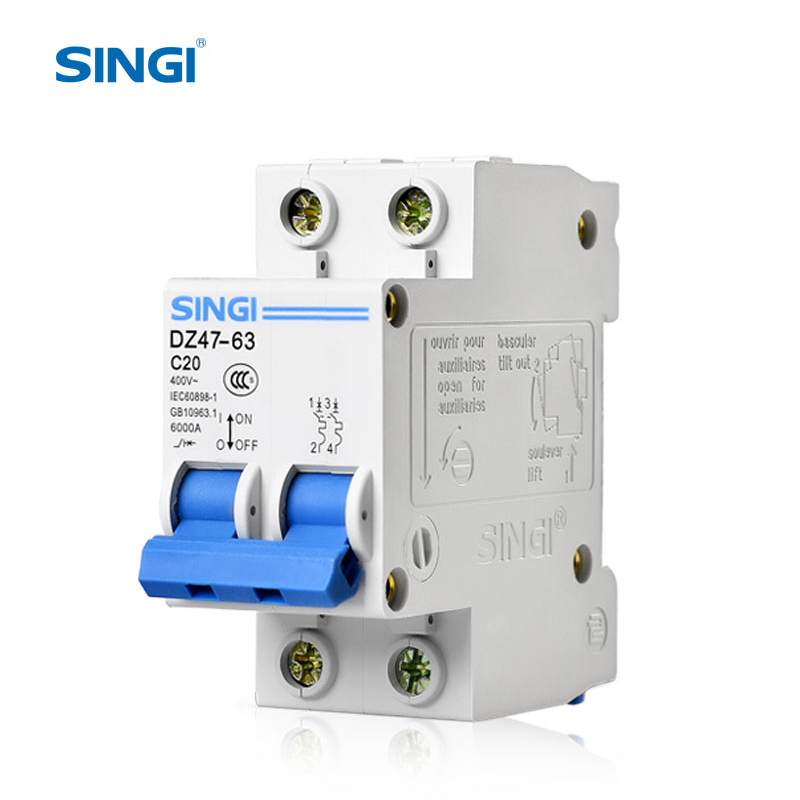
The DZ47 (4.5kA) miniature circuit breaker from SINGI is a thermal-magnetic DIN-rail device built for final distribution circuits in residential, commercial and light industrial installations. Its 4.5kA rated short-circuit capacity covers panels fed by distribution transformers where cable impedance keeps prospective fault amperage at modest levels. This guide covers breaking capacity, tripping curves, pole choice, derating and verification checks for engineers, distributors and project buyers. Full specifications sit on the SINGI DZ47 miniature circuit breaker product page.
A miniature circuit breaker sits at the end of the protection chain. It guards final circuits — lighting, socket outlets, small motors, HVAC controls — against overload and short circuit, and it gives the operator a manual isolation point for maintenance.
The DZ47 from SINGI is a 35mm DIN-rail device occupying one 18mm module per pole. It is available in 1P, 1P+N, 2P, 3P and 3P+N configurations with rated currents across the common 6A to 63A band and rated volt-level of 230/400V AC at 50/60Hz. That spread covers most single-phase final circuits and three-phase sub-distribution in commercial buildings.
The 4.5kA figure refers to rated short-circuit breaking capacity — the largest prospective fault amperage the device can interrupt at rated volt-level without damage to itself or danger to the operator. In a typical 400V/230V system fed by a 630kVA or 1000kVA transformer, fault amperage at a final circuit is limited by cable length and conductor cross-section, so 4.5kA is a practical match for the last two or three levels of distribution.
Contacts open. An arc forms. The breaker must push that arc into a splitter plate stack, cool it, and extinguish it before the fault amperage reaches its first peak. If the interrupting rating is below the available fault current, the arc sustains, the case ruptures, and the failure becomes a fire event than a trip.
That is why breaking capacity is the first number to check, ahead of price, brand or lead time. A device rated below the prospective fault amperage at its installation point is a misapplication regardless of how well it performs elsewhere.
Worked logic for choosing between capacity classes:
| Breaking capacity class | Typical installation point | Available fault amperage at point | Practical use |
|---|---|---|---|
| 3kA | Long sub-main runs, rural supplies, small final boards | Low, heavily cable-limited | Cost-driven domestic boards |
| 4.5kA | Final distribution boards in commercial and light industrial buildings | Moderate, 1.5kA to 4kA typical | DZ47 territory — lighting, sockets, small drives |
| 6kA | Main and sub-main boards closer to the transformer | 3kA to 5.5kA | Higher-margin panels, some industrial feeders |
| 10kA | Plant rooms, MCCs, points near large transformers | Above 6kA | Where upstream impedance is low |
Choosing 4.5kA where the fault level reaches 8kA does not improve safety margin. It removes it. Conduct a short-circuit calculation, or obtain one from the panel designer, before locking the bill of materials.
The DZ47 uses two tripping elements in series with the amperage path.
The arc that forms when the contacts part is drawn into a stack of steel splitter plates, divided into short segments, cooled and quenched. Research on arc motion inside miniature circuit breaker arc chambers shows that faster contact separation and a stronger magnetic driving field shorten arc dwell time and reduce contact erosion — the design direction behind current-limiting behaviour in compact devices [3].
The DZ47 also provides a trip-free mechanism: the breaker trips even if the toggle is held in the ON position. That prevents a defeated trip during fault conditions.
Field note: A 4.5kA miniature circuit breaker from SINGI carries a rated amperage that assumes 30°C reference ambient. Enclosure temperatures in a loaded panel run 45°C to 55°C. Apply the manufacturer derating factor, or move up one amperage step, before approving the schedule.
Curve choice decides whether the breaker trips on normal inrush or refuses to trip on a genuine fault. The DZ47 is offered in B, C and D characteristics.
| Curve | Magnetic trip range | Load type | Common misapplication |
|---|---|---|---|
| B | 3–5 × In | Resistive loads, lighting circuits, socket outlets with low inrush | Fitted to motor circuits, trips at start-up |
| C | 5–10 × In | Fluorescent lighting, small pumps, fans, general mixed loads | Used where fault amperage is low, trip time lengthens |
| D | 10–20 × In | Transformers, compressors, welders, high-inrush drives | Used on circuits with poor earth loop, disconnection time fails |
Two constraints run together. The magnetic threshold must sit above the load inrush, and the circuit's earth fault loop impedance must be low enough to deliver that threshold amperage within the disconnection time required by the wiring regulations in force. C curve is the workhorse choice for commercial fit-outs; B curve for pure lighting and socket circuits; D curve only where the supply impedance supports it.
Five checks catch most specification errors before the order is placed:
Procurement teams working with a SINGI miniature circuit breaker distributor can request the derating tables and time-amperage curves in advance. Curve data removes guesswork during the chooseivity study.
Two derating factors apply to every thermal-magnetic miniature circuit breaker.
Temperature. The bimetal responds to heat, so a breaker in a hot enclosure trips earlier than its nameplate suggests. A device rated 32A at 30°C may carry only 28A at 50°C. Panels in plant rooms, roof voids and direct-sun enclosures need the derating applied at design stage, not discovered at commissioning.
Grouping. Breakers mounted side by side share heat. Continuous banks of six or more fully loaded devices accumulate thermal rise and shift the trip point. Standards practice is to apply a grouping factor, or to leave spare ways, when the total connected load approaches the board rating.
Both effects compound. A fully loaded, tightly grouped bank in a warm enclosure can lose a meaningful share of its nominal capacity — enough to cause nuisance trips on circuits that are, on paper, correctly sized.
Miniature circuit breakers for household and similar installations are tested to IEC 60898-1; industrial-application devices follow IEC 60947-2. Both define rated short-circuit capacity, trip characteristics, mechanical and electrical endurance, and temperature-rise limits [1]. Regional equivalents include GB/T 14048.2 in China and UL 489 in North America [2][4].
A device marketed with a 4.5kA rating should carry test evidence against one of these frameworks. Buyers should ask for the test report reference, not a logo alone. Rated conditional short-circuit capacity (Icn) and rated service short-circuit capacity (Ics) are distinct values — Ics confirms the breaker remains serviceable after clearing a fault, and it is the figure that matters for lifecycle cost.
Verify three items on the datasheet: rated current, rated volt-level, and breaking capacity stated with the standard it was tested to. A capacity number without a standard reference carries little weight.
Panel builders and distributors reorder the same breaker for years. What separates suppliers is consistency between batches, availability of accessories, and the speed of a technical answer when a client asks derating or chooseivity at 5pm on a Friday.
A supplier who ships curve data, certificates and derating tables with the first order saves the buyer a week of specification work on the second. Ask for sample units before committing to a container load, run them through the intended duty cycle, and check terminal torque retention after repeated connection.
Q: Is a higher breaking capacity always the better choice?
A higher rating costs more and improves anything where the fault level is low. Match capacity to the calculated prospective fault amperage at the installation point, then add margin according to project policy.
Q: Can a 4.5kA miniature circuit breaker replace a 6kA unit in an existing board?
Only after checking the fault level at that board. A direct swap changes the safety margin. If the calculated fault amperage is below 4.5kA with the required margin, the substitution is sound; otherwise the board needs a higher-rated device or upstream amperage limiting.
Q: What is the difference between Icn and Ics?
Icn is the ultimate breaking capacity, proven by test without requiring the breaker to remain usable. Ics is the service breaking capacity, after which the device still functions. For procurement decisions, Ics carries more weight.
Q: How many poles should a final circuit use?
Single-phase circuits use 1P or 1P+N where neutral isolation is required. Three-phase circuits use 3P, and 3P+N where the neutral must be switched or protected. Distribution practice and local code decide the final answer.
Q: How can a buyer judge a miniature circuit breaker supplier ?
Look at documentation quality, batch consistency, accessory availability and response speed on technical questions. A supplier who answers a derating question with a table instead of a promise is easier to build a long-term order pattern .
SINGI supplies the DZ47 (4.5kA) miniature circuit breaker in 1P through 3P+N configurations with B, C and D curves, backed by test documentation and technical support for chooseivity and derating studies. Review the full range and request samples on the SINGI DZ47 miniature circuit breaker page.
[1] IEC 60947-2. Low-volt-level switchgear and controlgear - Part 2: Circuit-breakers [S]. 2020.
[2] UL 489. Molded-Case Circuit Breakers, Molded-Case Switches and Circuit-Breaker Enclosures [S]. 2021.
[3] Wang Jianjun, Liu Zhigang. Research on the application of nanocrystalline arc-extinguishing grid in amperage limiting technology of low-volt-level circuit breaker [J]. Low Volt-level Apparatus, 2023, (5): 45-52.
[4] GB/T 14048.2-2020. Low-volt-level switchgear and controlgear - Part 2: Circuit breakers [S]. 2020.