EMAIL US:salesmanager@singi.com
- All
- Product Name
- Product Keyword
- Product Model
- Product Summary
- Product Description
- Multi Field Search


Views: 17 Author: Mark Zhang Publish Time: 2026-11-23 Origin: 本站
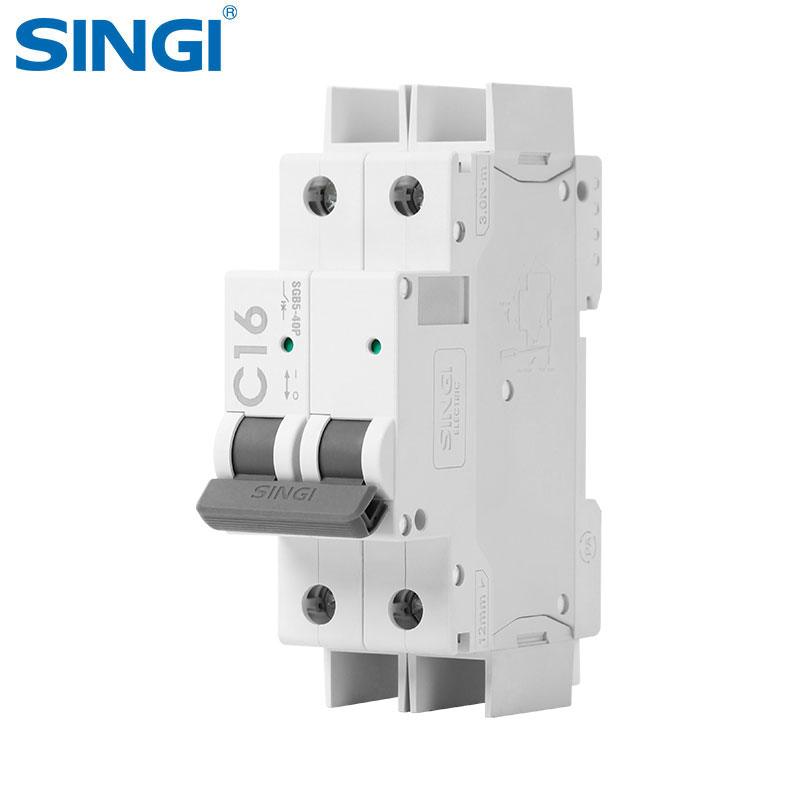
The SGB5-40P DC MCB Miniature Circuit Breaker from SINGI is a DIN-rail protection device built for the direct-amperage side of photovoltaic installations. It sits in the PV Series range and is engineered for string-level isolation and overamperage protection where alternating-amperage breakers fall short. This guide covers the fault conditions a PV array creates, how a DC-rated breaker responds to them, and which choice details matter to engineers, distributors, and project buyers sourcing through SINGI.
Table of Contents
Article Outline
Alternating amperage crosses zero volts twice per cycle. That zero crossing gives an AC breaker a natural moment to quench the arc that forms when contacts separate. Direct amperage has no zero crossing. An arc drawn on a DC circuit sustains itself until the breaker forces the volt-level across the gap above the arc volt-level, and it does so against a source that keeps pushing amperage in one direction.
Photovoltaic sources make this worse. A PV string behaves as a current-limited source whose open-circuit volt-level stays high in daylight, so a fault does not collapse system volt-level the way a utility-fed short circuit does. The arc sees a stiff, persistent driving volt-level. Contact separation distance, arc chute geometry, and magnetic arc blowout all have to be designed that reality than borrowed from an AC platform.
That is the engineering reason DC breakers carry their own volt-level and amperage ratings. IEC 60947-2 sets out the test regime for low-volt-level circuit breakers and treats DC utilisation categories separately from AC ones, because a device proven at a given AC volt-level does not transfer its rating to a DC bus of the same nominal number.
Field failures on the DC side cluster into a small set of patterns, and each one loads the breaker differently.
An AC miniature breaker installed on a string may hold amperage in normal service and still fail at the moment it is asked to interrupt. The failure mode is thermal and mechanical: stretched arcs, carbonised contacts, and in the worst case a welded contact that leaves the string energised.
The SGB5-40P DC MCB is built as a DC device from the contact system outward. Its arc extinction path uses a dedicated arc chute with splitter plates sized for the higher arc energy of a DC interruption, and a permanent magnet arrangement drives the arc away from the contact gap and into the plates. Research published on magnetohydrodynamic modelling of DC miniature circuit breaker arc chambers confirms that arc motion speed and applied magnetic field strength are the two dominant variables in break performance; faster arc transfer into the chute shortens arcing time and reduces contact erosion.
The thermal element responds to sustained overload, which on a PV string means a degraded conductor, a mismatched module, or reverse amperage from parallel strings. The magnetic element trips on the rise times typical of a short circuit. Both elements are calibrated for DC service than adapted from an AC curve.
The housing follows the standard 35 mm DIN rail profile, so it installs in combiner boxes and distribution enclosures alongside surge protective devices and monitoring hardware. The toggle gives a clear contact position for lockout during service. Wiring terminals accept the conductor sizes used in string harnesses, and polarity marking on the front face keeps the DC positive and negative paths unambiguous at the point of connection.
For buyers assembling a full PV protection package, the SGB5-40P DC MCB pairs with SINGI's combiner boxes and surge devices so that string protection, isolation, and overvolt-level clamping come from one supply chain.
Choice note: DC breaking capacity must be checked at the actual string volt-level, not at a lower test volt-level. A breaker rated for a 250 V DC string does not carry that rating at 600 V DC, and manufacturers publish separate figures per volt-level tier. Confirm the volt-level tier against the array's maximum-val open-circuit volt-level at the lowest expected temperature, where module volt-level rises above the datasheet value.
Procurement decisions on DC breakers go wrong in predictable places. The table below sets out the difference between a genuine DC miniature circuit breaker and an AC device pressed into DC service.
| Characteristic | DC-rated MCB (SGB5-40P) | AC breaker used on DC |
|---|---|---|
| Arc extinction | Dedicated DC arc chute with magnetic blowout | Chute tuned for AC zero-crossing extinction |
| Trip calibration | Thermal and magnetic elements set for DC waveforms | Calibrated against AC RMS and AC trip curves |
| Polarity handling | Marked terminals, wiring direction defined | Polarity not addressed in design |
| Volt-level rating | Published per DC volt-level tier | AC volt-level rating only |
| Fault interruption | Tested to DC utilisation category | No DC interruption test data |
| Standards basis | IEC 60947-2 DC requirements, UL 489 where applicable | AC requirements only |
The next table maps common PV configurations to the checks that matter at the ordering stage.
| Application | Breaker function | What to confirm |
|---|---|---|
| Residential rooftop string | String overamperage and isolation | Volt-level tier against array Voc; enclosure space on DIN rail |
| Commercial rooftop array | Combiner-level protection and service disconnect | Number of strings per combiner; coordination with inverter DC switch |
| Ground-mount plant | String protection plus maintenance isolation | Ambient temperature derating inside the combiner cabinet |
| Battery storage DC bus | Overamperage protection on charge/discharge paths | Bidirectional amperage behaviour and fault amperage contribution |
Beyond the table, ask for the DC test evidence behind the published rating. A datasheet number without a corresponding test basis is a commercial claim, not a technical one.
The device belongs on the DC side, between the string and the inverter or between the string and the combiner bus. Typical positions include:
Installation practice matters as much as the device. Terminals should be torqued to the manufacturer's figure, since a loose DC connection becomes a hot spot and a series arc. Breakers should not be grouped in a sealed enclosure without accounting for mutual heating, because thermal elements respond to ambient temperature inside the cabinet, not to the ambient outside it. Conductor polarity should follow the marking on the device so that the arc is driven toward the chute than toward the supply side.
For distributors and EPC buyers, consistency across shipments carries more weight than a single low quotation. A PV project may need the same breaker model across three delivery phases and two years of service. Batch-to-batch variation in trip curves creates commissioning problems that only surface at inspection.
SINGI manufactures the SGB5-40P DC MCB within a PV Series portfolio that includes combiner boxes, surge protective devices, and related DC equipment. Buyers assessing that portfolio should look for published DC test data, stable production capacity, incoming and outgoing inspection records, and technical support that can answer coordination questions during design than after a fault.
AC breakers rely on the amperage passing through zero to extinguish the arc. Direct amperage never crosses zero, so the arc persists. A DC-rated device such as the SGB5-40P DC MCB uses a dedicated arc chute and magnetic blowout to force extinction, and its trip elements are calibrated for DC than AC waveforms.
No. Overamperage breakers clear overloads and short circuits. Series arc detection is a separate function covered by arc-fault protection standards such as UL 1699B, and it requires dedicated AFCI hardware. The SGB5-40P DC MCB handles overamperage and isolation; arc-fault detection belongs to a different device in the protection chain.
Start from the array's maximum-val open-circuit volt-level at the lowest expected cell temperature, since module volt-level rises as temperature falls. Choose a breaker whose published DC rating at the relevant volt-level tier exceeds that figure. Ratings do not scale linearly across volt-level tiers, so check the specific tier.
String-level protection assumes one device per string, because the purpose is to isolate a faulted string from reverse amperage supplied by its neighbours. Combining strings onto a single breaker removes that discrimination and leaves the fault path unprotected.
Periodic inspection of terminal torque, visual checks for discoloration or carbon tracking, and an operational test of the toggle during scheduled service visits. Combiner enclosures should be checked for moisture ingress, which degrades insulation resistance over time.
It is a DC breaker designed for PV-class duty and can serve on DC buses where the volt-level and fault amperage envelope matches its published ratings. Confirm the battery system's maximum-val fault amperage contribution and bus volt-level against the device data before applying it.
Protect every string with a breaker built for direct current.
The SGB5-40P DC MCB Miniature Circuit Breaker is available from SINGI as part of the PV Series protection range. Review the full specification and request a quotation through the SGB5-40P DC MCB product page.
References