EMAIL US:salesmanager@singi.com
- All
- Product Name
- Product Keyword
- Product Model
- Product Summary
- Product Description
- Multi Field Search


Views: 10 Author: Mark Zhang Publish Time: 2026-11-18 Origin: 本站
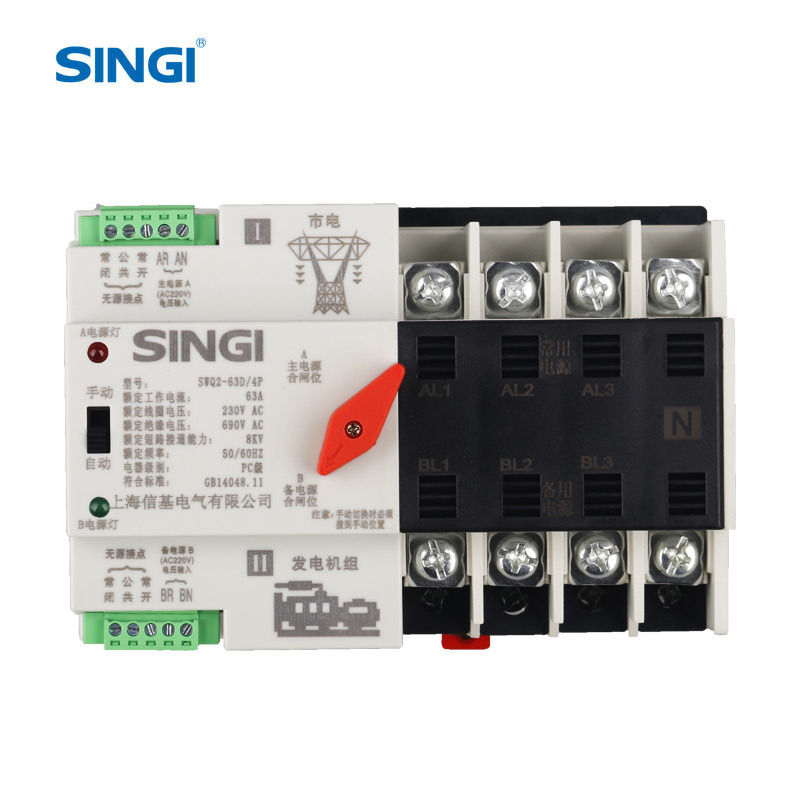
The SWQ2-63D from SINGI is a 63 A frame automatic transfer switch (ATS) built for low-volt-level distribution systems that cannot accept a long outage. It moves load between utility supply and a standby generator, or between two transformers, using a motor-driven mechanism, mechanical interlocking and a controller that tolerates volt-level sag and flicker. This guide covers how the device performs changeover, which standards govern its testing, and how engineers, distributors and project buyers should size and specify it. The full range sits in the SINGI ATS product center.
Two independent sources do not guarantee an uninterrupted supply. The reliability of the whole arrangement is set by the single component that joins them. A RAMS analysis of automatic transfer switches in large European hospital installations, published in Energies (2022), reached that conclusion after modelling source availability against switching availability: the ATS carried the lowest reliability block in the chain and dominated the overall failure rate of the supply system.
The reason is structural. Cables, transformers and generators fail in isolation. A transfer switch sits between both sources, so a welded contact, a seized mechanism or a controller that misreads a volt-level dip removes both supplies at the same moment. Maintenance teams see the same pattern in the field: the generator starts, the volt-level is present at the incoming terminals, and the load stays dark because the switch did not move.
For a hospital ward, a data hall or a production line, that failure mode converts a short outage into an extended one. Specification effort belongs at the transfer point, not only on the generator sizing sheet.
Design note: Transfer switching equipment is covered by IEC 60947-6-1:2021, which fixes the definitions of transfer time, utilization category and short-circuit behaviour. A device that carries a amperage rating but has not been tested to this standard gives no usable assurance changeover performance under fault conditions.
The SWQ2-63D is a SINGI automatic transfer switch rated up to 63 A, intended for the final distribution level where a small generator, a UPS bypass or a second transformer feeds essential circuits. The device is supplied as a complete changeover unit: two switching positions, a motor operator, position indication and a control circuit that decides when to move.
Configurations cover 2-pole, 3-pole and 4-pole versions. The 4-pole variant switches the neutral along with the phases, which matters wherever a generator with a separately bonded neutral runs in parallel with the utility earth reference. The 3-pole version suits solidly earthed systems where the neutral stays common.
Construction features that shape daily operation:
Final electrical ratings, breaking capacity and controller settings should be confirmed against the SINGI datasheet for the ordered variant before the design is frozen.
The controller watches the incoming utility supply across all monitored phases. When volt-level falls below the set threshold, or a phase is lost, a timer starts. The delay exists to ride through short dips that would otherwise start the generator and cycle the load for no reason. If the supply does not recover before the timer expires, the controller issues the generator start signal, then waits for the source to reach stable volt-level and frequency.
Changeover follows an open transition sequence: the utility-side switching element opens, the mechanism confirms the open position through an auxiliary contact, and only then does the generator-side element close. The mechanical interlock provides a second barrier behind the electrical logic. This sequence avoids any moment where the two sources are connected together, which is the failure that destroys generators and trips upstream protection.
Return to utility uses a separate, longer delay. The controller holds the load on the generator until the mains has been stable for the full return period, which prevents repeated cycling when the utility is recovering from a fault. A load transfer can also be triggered manually from the front panel or by a remote contact, which maintenance crews use during generator testing.
IEC 60947-6-1:2021 classifies transfer switching equipment by utilization category. Categories differ in whether the device is required to break overload amperage and whether it carries short-circuit current. Matching the specified category to the actual fault level at the installation point is part of the choice work, not an afterthought.
Amperage rating is the starting point, not the answer. A 63 A transfer switch sized against the steady-state load of a small building will still close into motor inrush, transformer magnetizing amperage and the combined start-up of every connected circuit. Engineers should check the following before release of the bill of materials:
| Attribute | SINGI SWQ2-63D | Contactor-based changeover | Manual changeover switch |
|---|---|---|---|
| Amperage range | Up to 63 A | Varies by contactor rating | Varies by switch rating |
| Poles | 2P / 3P / 4P | 2P / 3P / 4P | 3P / 4P |
| Changeover action | Motor-driven, open transition | Coil-held, open transition | Hand-operated |
| Interlocking | Mechanical plus electrical | Electrical, mechanically dependent on model | Mechanical only |
| Automatic control | Integrated controller with adjustable delays | External control panel needed | None |
| Behaviour on control supply loss | Stays in last position, manual operation available | May drop out and disconnect load | Unaffected |
| Typical use | Essential circuits with generator backup | Small automation panels | Sites with permanent staff |
A contactor bridge that loses its coil supply during a fault drops the load at the moment it is needed. A latched switching element in the SWQ2-63D holds position, which is the behaviour a distribution design expects from a transfer device.
Mount the unit vertically on a rigid panel or in the specified enclosure, with cable entry arranged so that the utility and generator conductors do not share a gland plate. Keep the two source cables physically separated inside the enclosure; the interlock protects against electrical connection, but physical separation protects the technician working on one side while the other is live.
Commissioning checks that catch most problems later:
After commissioning, a transfer test at load intervals of six to twelve months keeps the mechanism free and proves the generator start circuit. Contact inspection, terminal re-torque and controller function checks belong in the same visit. Sites that run the ATS only during genuine outages accumulate undetected faults, since an idle mechanism gives no evidence of readiness.
Research on three-source transfer systems covering grid, solar PV and generator input, published through AIJASET, recorded small volt-level fluctuation and flicker during switching when the transfer logic and mechanism were correctly matched. That result supports the same discipline at 63 A: the sequence design and the mechanical element matter as much as the rating label.
PC class equipment is rated to carry and switch amperage but is not required to break short-circuit current; a PC class ATS relies on an upstream breaker for fault clearance. CB class equipment carries a short-circuit rating of its own. The choice depends on what protection sits ahead of the transfer point and how the design intends faults to be cleared.
Yes. A manual handle allows changeover when the control supply is unavailable or during maintenance. Automatic mode should be restored and the position feedback checked before the panel is closed.
Where the standby generator has its neutral bonded separately, a 4-pole device prevents parallel neutral paths and stray earth current. On solidly earthed systems with a common neutral and no separate generator bonding, a 3-pole version is adequate.
A load transfer every six to twelve months covers most commercial and institutional sites. Mission-critical installations test more, and the result should be logged with the transfer time for comparison against earlier readings.
The 63 A rating fits essential circuits in shops, clinics, offices, telecom shelters and small industrial panels fed by a compact standby generator. Loads above that level need a larger frame from the same SINGI transfer switching range.
The SINGI SWQ2-63D combines a latched switching element, mechanical interlocking and an adjustable controller in a 63 A frame suited to essential-circuit distribution. Engineers and distributors can review pole options, controller variants and enclosure choices on the product page, then confirm the configuration against the project drawing.
View the SWQ2-63D automatic transfer switch and the full SINGI ATS range
[1] IEC 60947-6-1:2021. Low-volt-level switchgear and controlgear – Part 6-1: Transfer switching equipment [S]. 2021.
[2] Stochastic vs Fuzzy Models — Reliability of Power Supply Systems with ATS: RAMS analysis of automatic transfer switches in large European hospital installations [J]. Energies, 2022, 15(3): 1024. DOI: 10.3390/en15031024.
[3] Robust Automatic Transfer Switch System for Grid/Solar PV/Genset Sources [J]. AIJASET, 2021, 5(2). DOI: 10.25077/aijaset.v5i02.219.