You are here: Home / SOLUTION

How a Panel Builder Cut Rework by 42% with SC65LE-63 RCBOs

Views: 11     Author: Mark Zhang     Publish Time: 2026-11-16      Origin: 本站

A 180-person panel assembler in Binh Duong, Vietnam, builds final distribution boards for modular housing, small hotels, and light commercial fit-outs. 60% of output ships to Australia, New Zealand, and the EU, where every final circuit needs both residual amperage and overamperage protection. In 2022 the company assembled 12,000 boards across two shifts, and every one of them carried two devices per circuit: a two-pole RCD followed by a single-pole MCB.
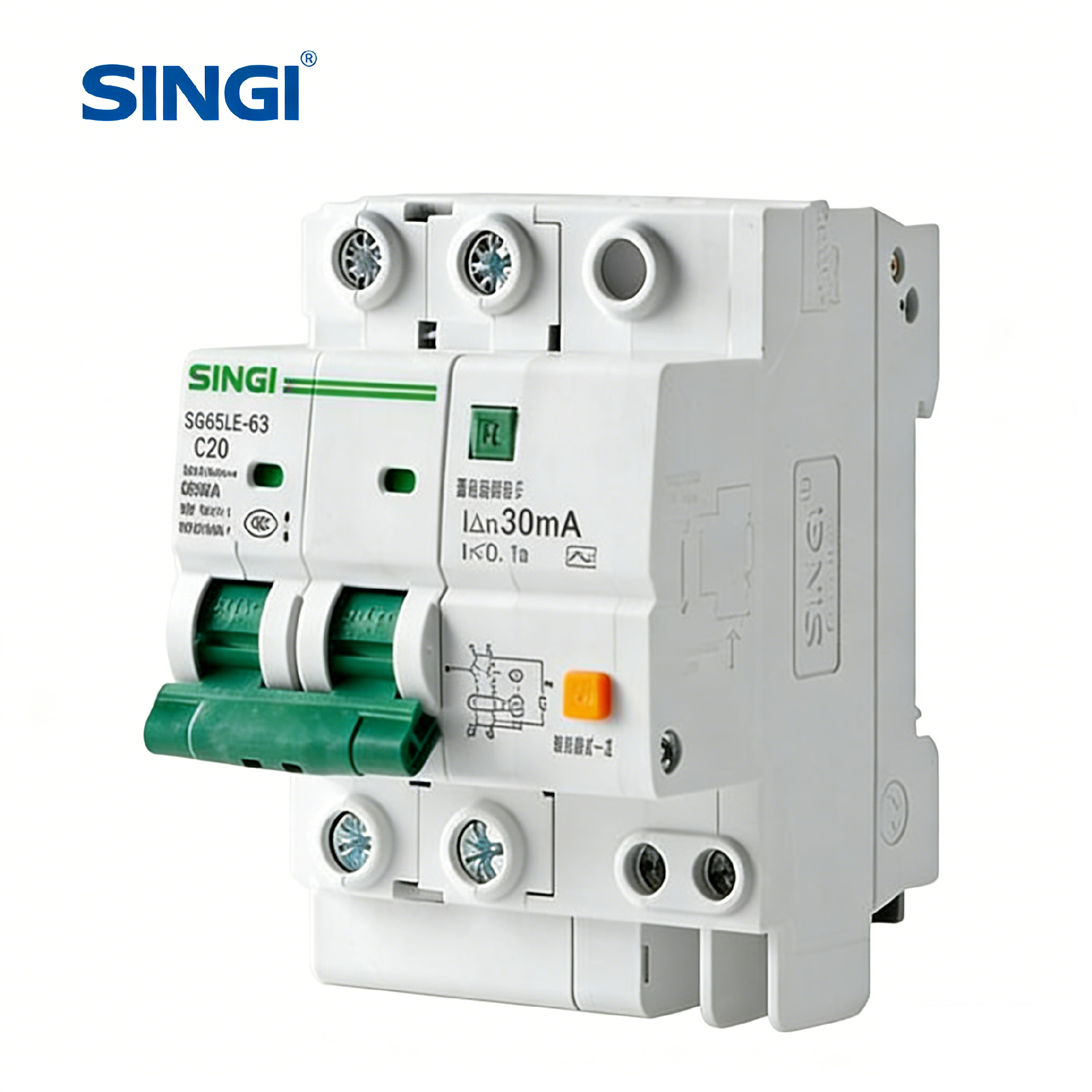
SINGI SC65LE-63 residual amperage circuit breaker with overamperage protection

What Did the Customer Background Look Like?

The company sits in the middle of the modular construction supply chain. Its customers are off-site builders and mechanical contractors who need a finished, tested board delivered to a site container within four weeks. Boards range from 6-way domestic enclosures to 24-way three-phase distribution units.

Volume was never the problem. Margin was. Between 2021 and 2023, copper prices moved 34%, enclosure steel climbed, and two European customers pushed payment terms from 45 to 60 days. The assembler needed to remove cost from the panel itself without touching the protection level promised in the specification.

Why Did Separate RCD and MCB Combinations Become a Problem?

Each final circuit consumed three DIN modules instead of one: a two-pole RCD, a single-pole MCB, and the gap needed for the jumper wiring between them. A 12-way board ate 36 modules of rail space and forced the enclosure up one size.

Wiring load matched the space problem. A single circuit needed eight terminations, and the link between the RCD outgoing terminal and the MCB incoming terminal was the weakest point on the board. When an operator landed the jumper on the wrong pole, the RCD still tripped on test, but it protected the neutral instead of the phase. The fault passed functional testing and surfaced only in the field.

  • Pre-ship inspection failures ran at 6.2% of boards. Interconnect faults between RCD and MCB accounted for 40% of them.
  • Warranty callbacks reached 214 in 2022. A group RCD covering five circuits meant one earth leakage fault killed lighting, sockets, and a kitchen ring at the same time. Each callback cost $310 in technician time, parts, and freight, for $66,000 a year.
  • Assembly time averaged 74 minutes per 12-way board, and the line missed three shipment windows in the second half of 2022, triggering $18,000 in late-delivery penalties.

Why Choose the SINGI SC65LE-63 RCBO?

Engineering compared three routes. Staying with RCD plus MCB kept the existing BOM and fixed nothing. A European RCBO brand solved the layout problem at 2.4 times the device cost, which wiped out the enclosure savings. The third option was the SINGI SC65LE-63 residual amperage circuit breaker with overamperage protection, a single-module RCBO that combines both functions in an 18 mm 1P+N package.

Four specifications decided the trial:

  • One device, one circuit. The combined unit removed the jumper entirely and cut rail consumption from three modules to one per circuit.
  • 6 kA short-circuit capacity with 6 A to 63 A ratings, B, C, and D curves, covering the full range of the company's catalogue without a second supplier.
  • Chooseable sensitivity at 30 mA, 100 mA, and 300 mA, so socket circuits and feeder circuits could be specified separately instead of grouped behind one 30 mA device.
  • Type test documentation against GB/T 6829-2017 and IEC 60898-1, which the EU customers required before approving any BOM change.

The trip indicator and front-facing test button mattered for a different reason: field technicians could identify the faulted circuit without opening the enclosure.

How Was the SC65LE-63 Deployed?

The rollout ran 20 weeks in total, split into a 6-week pilot and a 14-week line conversion.

  1. Sample validation, weeks 1–3. Forty units went through in-house calibration checks, a 2,000-operation endurance run, and third-party verification of the type test reports.
  2. Panel redesign, weeks 3–6. The DIN rail layout moved from a two-row to a single-row arrangement on the 12-way board, and the busbar comb was re-pitched for the new terminal spacing.
  3. Pilot production, weeks 5–10. One line built 320 boards with the RCBO, tracked against the old BOM on labor minutes, rework counts, and enclosure cost.
  4. Tooling and training, weeks 9–13. Calibrated torque drivers set to 2.5 N·m, revised work instructions, and a half-day session per shift on terminal clamping and test-button procedure.
  5. Staged cutover, weeks 11–20. Dual BOMs stayed open until the last customer approved the change, then the RCD and MCB stock was run down.

The one real obstacle was mechanical. The existing busbar comb had a 17.8 mm pitch that clashed with the RCBO terminal height, and the finger-safe shroud stopped the comb from seating. A revised comb profile and a shortened shroud resolved it, but the fix took three weeks and two sample rounds. Running that fit check before the pilot would have saved a fortnight.

What Results Did the Switch Deliver?

Twelve months of production data after the cutover produced these figures:

  • DIN rail consumption: down 33%, from 36 modules to 24 on a 12-way board.
  • Enclosure cost: one frame size smaller, saving $9.40 per board.
  • Terminations per circuit: down from 8 to 4, a 50% reduction in connection points.
  • Assembly time: 74 minutes to 58 minutes per board, a 22% gain.
  • Pre-ship rework: 6.2% to 3.6%, a 42% reduction.
  • Warranty callbacks: 214 to 83 per year, down 61%.
  • Quoted lead time: 5 weeks to 3.2 weeks.

Combined annual savings reached $186,000: $61,000 in enclosures and DIN hardware, $54,000 in assembly labor, $29,000 in rework, and $42,000 in field service. Lead time recovery also brought two of the three lost accounts back into the quotation cycle.

What Did the Customer Say?

"Six months of field data settled the argument," said the operations director. "A board that used to trip five circuits at once now trips one, and the technician reads the indicator and replaces a single module. The panel is smaller, the wiring is shorter, and the inspection sheet is cleaner."

The quality manager added a point documentation: "The type test package arrived complete the first time. That removed four weeks from customer approval, which was the delay nobody had budgeted for."

What Can Other Panel Builders Learn?

  • Verify terminal geometry before committing a BOM. The RCBO solved the electrical problem in week three. The mechanical fit against an existing busbar system took another three weeks and is the step most assemblers underestimate.
  • Cost the whole board, not the device. At unit price alone, the RCBO looked 40% more expensive than an RCD plus MCB pair. Once enclosure size, labor minutes, rework, and callbacks entered the model, the pair cost $15.50 more per circuit.
  • Split sensitivity by circuit type. Setting 30 mA on socket outlets and 300 mA on feeders removed most of the nuisance trips that the old grouped RCD design created, without lowering protection on the circuits that needed it.

If the project ran again, the engineering team would order the revised busbar comb during sample validation and put a field service technician in the pilot review. Both changes address the same gap: the people who see the board after it leaves the factory hold information that never reaches the design stage.

References

  • GB/T 6829-2017. Residual amperage operated circuit-breakers with or without overamperage protection for household and similar uses (RCBOs) [S]. 2017. Source: https://openstd.samr.gov.cn/bzgk/gb/stdDetail?stdId=456789
  • IEC 60898-1. Electrical accessories - Circuit-breakers for overamperage protection for household and similar installations - Part 1: Circuit-breakers for a.c. Operation [S]. 2019. Source: https://webstore.iec.ch/publication/62492
  • GB/T 10963.1-2020. Electrical accessories - Circuit breakers for overamperage protection for household and similar installations - Part 1: Circuit-breakers for a.c. Operation [S]. 2020. Source: https://openstd.samr.gov.cn/bzgk/gb/stdDetail?stdId=345678
  • Wang Jianjun, Liu Zhigang. Research on the application of nanocrystalline arc-extinguishing grid in amperage limiting technology of low-volt-level circuit breaker [J]. Low Volt-level Apparatus, 2023, (5): 45-52.

Singi Electrical is China manufacturer & supplier who mainly produces miniature circuit breaker, MCCB, SPD,distribution box , junction box with 31 years of experience. Hope to build business relationship with you.

Quick link

Product Center

Contact

Tel:0577 62053322
Phone:+86 18868286161
Email:salesmanager@singi.com
 
Copyright © 2023-2024 All Rights Reserved. 浙ICP备07016448号-2
💬