EMAIL US:salesmanager@singi.com
- All
- Product Name
- Product Keyword
- Product Model
- Product Summary
- Product Description
- Multi Field Search


Views: 8 Author: Mark Zhang Publish Time: 2026-11-15 Origin: 本站
A mid-sized solar installation company based in the southwestern United States specializes in residential and commercial photovoltaic (PV) systems. With 120 employees and over 1,200 installations completed annually, the company has built its reputation on reliable, code-compliant work. However, intense competition and rising labor costs have squeezed margins, forcing the firm to seek every efficiency gain possible. The operations team noticed that service callbacks— those related to DC circuit protection—were eroding profitability and straining customer relationships.
In PV arrays, DC miniature circuit breakers (MCBs) protect wiring and equipment from overcurrents and short circuits. The installer had been using generic DC MCBs from several low-cost suppliers. These breakers tripped nuisance—without any actual fault— during hot summer months when ambient temperatures inside combiner boxes exceeded 50°C (122°F). Each false trip required a truck roll to reset the breaker, costing $250 per visit. The company averaged 150 such callbacks per year, translating to $37,500 in direct labor and vehicle expenses. Worse, customers perceived the system as unreliable, leading to negative reviews and lost referral business.
, the installer faced safety concerns. On two occasions, DC arc faults during array maintenance caused minor equipment damage. The generic MCBs lacked robust arc-extinguishing capability, and their thermal calibration drifted with temperature changes. The team tried adjusting trip curves and installing separate DC isolators, but neither solved the root cause. Problem was that the breakers were not designed for the harsh DC and thermal conditions of PV systems.
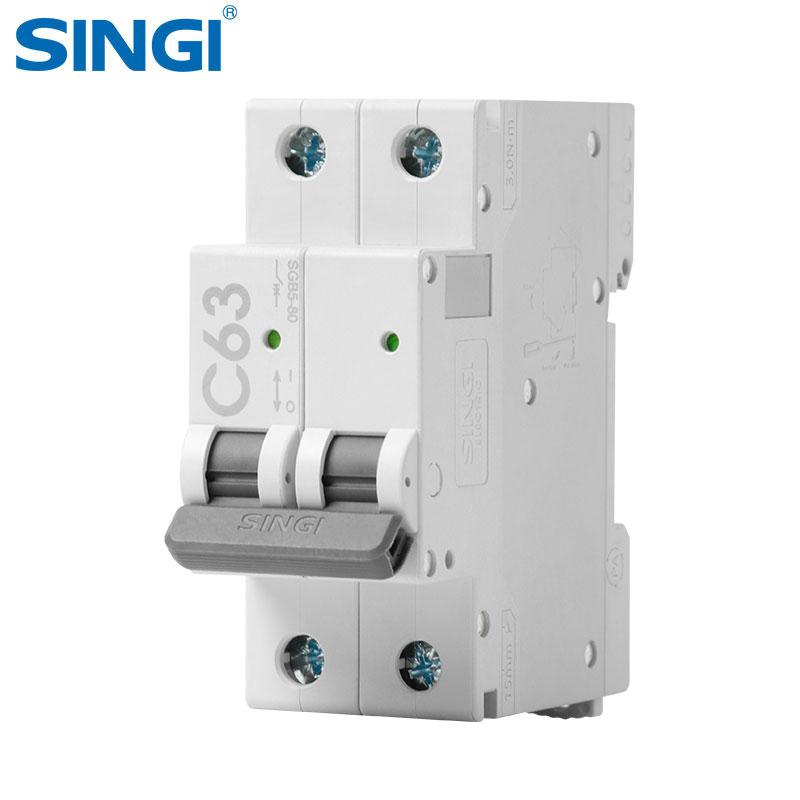
The installer assessed three alternatives: a premium European brand, a mid-range Asian brand, and the SINGI SGB-80 DC MCB. While the European brand performed well, its unit cost was 40% higher and lead times stretched to 12 weeks. The mid-range brand showed inconsistent tripping in lab tests. The SGB-80 stood out for three reasons:
After a 30-day side-by-side field test on 20 systems, the SGB-80 produced zero nuisance trips while the generic breakers tripped seven times. The decision was clear.
The rollout followed a three-phase plan over 10 weeks:
One challenge emerged during the pilot: some older combiner boxes had tight DIN-rail spacing, and the SGB-80’s terminal covers slightly interfered with adjacent wiring. The solution was simple—SINGI provided a low-profile terminal cover accessory, and the installer adjusted wire routing. This minor hiccup was resolved within a week and did not delay the timeline.
After six months of full deployment, the installer measured the following outcomes:
Overall, the installer achieved a 60% reduction in DC circuit faults (combining nuisance trips and arc events) and a total annual cost reduction of $57,700. Customer satisfaction scores rose from 3.8 to 4.6 out of 5, and referral rates increased by 18%.
“We were burning money on every false trip. The SGB-80 cut our callback rate to nothing and gave our installers confidence that the DC side would hold up—even in 110°F heat. It’s now the only breaker we stock.” — Operations Manager, Solar Installation Company
If the project were repeated, the operations manager notes that they would start the pilot in the hottest month of the year to stress-test thermal performance even further—though the SGB-80 already passed with zero trips.