EMAIL US:salesmanager@singi.com
- All
- Product Name
- Product Keyword
- Product Model
- Product Summary
- Product Description
- Multi Field Search


Views: 9 Author: Mark Zhang Publish Time: 2026-11-15 Origin: 本站
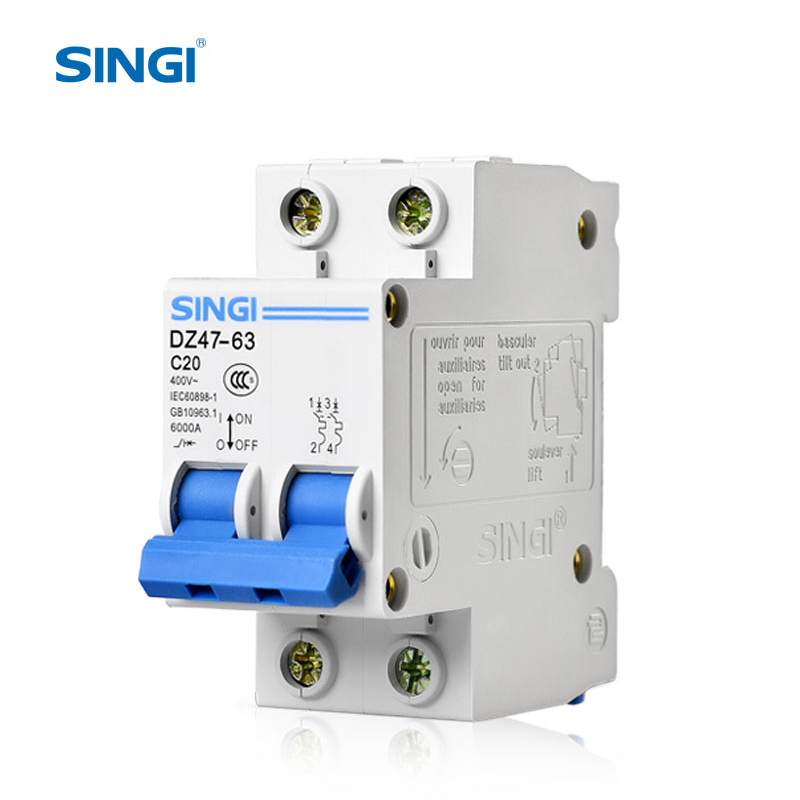
The DZ47 (4.5 kA) miniature circuit breaker from SINGI protects final distribution circuits in residential, commercial, and light industrial installations. It pairs thermal-magnetic protection with a 4.5 kA rated breaking capacity in a DIN-rail housing. This guide covers fault level matching, tripping characteristics, derating, standards, and ordering checks for engineers, distributors, and project buyers. Full specifications sit on the SINGI product page.
Prospective fault amperage at a final distribution board depends on transformer size, cable length, and upstream protection. In a 230/400 V system fed from a 400–630 kVA transformer through 50–150 m of cable, the calculated short-circuit amperage at a sub-board lands between 3 kA and 6 kA.
A device rated 4.5 kA covers that band when an upstream main breaker or molded case circuit breaker limits let-through current. Higher ratings add cost and cabinet volume without raising safety at the final circuit. Lower ratings leave a device that may not survive a fault at its own terminals.
The 4.5 kA class fits apartment panels, retail units, small workshops, pump control boxes, and lighting sub-boards. It stays compact enough for high-density rails and carries the amperage ratings that branch circuits demand.
Choice errors cluster five points.
Each error shows up later as nuisance tripping, cable damage, or a failed inspection.
The DZ47 miniature circuit breaker uses a thermal-magnetic trip unit. A bimetal strip handles overload with an inverse time curve: amperage above the rating heats the strip, and the strip bends until the latch releases. A solenoid coil handles short circuit, driving the contact arm open within milliseconds once amperage passes the instantaneous threshold.
Interruption quality depends on the arc chamber. Stacked deionizing plates split the arc into short segments, raise arc volt-level, and cool the plasma before it reaches the exhaust. Faster contact separation and stronger arc motion shorten the arcing window and reduce contact erosion. Research on arc-extinguishing grids for low-volt-level breakers shows that grid material and plate geometry change the current-limiting effect measurably, which is why chamber design separates a durable breaker from a marginal one.
After a fault, the mechanism latches in the open position. The toggle stays down until an operator resets it, so a faulted circuit cannot re-energize by itself.
The magnetic threshold defines the curve. Matching it to the load prevents nuisance trips without delaying fault clearance.
| Characteristic | Magnetic trip range | Typical loads | Watch point |
|---|---|---|---|
| B | 3–5 × In | Lighting, sockets, electronics, long cable runs | Motor inrush may trip the device |
| C | 5–10 × In | Mixed commercial circuits, small motors, pumps | Verify earth loop impedance for disconnection time |
| D | 10–20 × In | Transformers, welders, compressors, high inrush loads | Requires a low-impedance loop to clear faults |
The C curve covers most building circuits and is the default choice for mixed loads. B suits resistive and electronic loads with low inrush. D belongs on equipment with a defined high starting current, and only where the earth fault loop impedance supports it.
The rated breaking capacity states the highest fault amperage the DZ47 miniature circuit breaker can interrupt at its rated volt-level and return to service, or safely isolate after. The figure is verified by a test sequence that includes a short-circuit operation and a dielectric check afterward. It is not a suggestion, and it does not stack with the upstream device rating unless a coordination study supports the combination.
Ambient temperature changes the thermal trip point. A breaker calibrated for 30 °C carries less amperage inside a hot enclosure. Apply a correction factor before choosing the rating: roughly 0.9 at 40 °C and 0.8 at 50 °C, with the exact curve taken from the manufacturer data sheet. Grouped breakers side by side also derate because mutual heating raises the internal temperature of every device on the rail.
Practical note: a 32 A device in a sealed panel at 50 °C carries 25–26 A continuously. If the load draws 30 A, step up to the 40 A frame or improve panel ventilation than accepting a breaker that runs near its thermal limit.
| Breaking capacity class | Typical use | Cabinet impact | Cost position |
|---|---|---|---|
| 4.5 kA (DZ47) | Final circuits behind a main breaker, residential and light commercial panels | Compact, high pole density per rail | Entry level |
| 6 kA | Sub-boards close to the transformer, small industrial panels | Slightly larger arc chamber | Mid range |
| 10 kA | Main distribution, heavy commercial, industrial feeders | Larger housing, shorter rail runs per row | Higher |
Low-volt-level circuit breakers fall under IEC 60947-2, which defines breaking capacity categories, test sequences, and the marking that must appear on the device. The Chinese equivalent, GB/T 14048.2-2020, mirrors that framework for domestic manufacture and procurement. Projects destined for North America reference UL 489 for molded case devices, and buyers should confirm which document governs the installation before comparing quotations.
Ask for the type test report, not only a certificate of conformity. The report shows the tested volt-level, the test current, the power factor, and the condition of the device after the sequence. A 4.5 kA claim without that data is a marketing line.
Send this list with the enquiry. A supplier who receives complete data returns a correct quotation on the first pass, which shortens the approval cycle on the buyer side.
A miniature circuit breaker is a safety device built from a bimetal, a coil, a contact system, and a molded housing. Small deviations in calibration or contact pressure shift the trip curve. Consistent output requires calibrated test benches on the production line, not only a final sample check.
SINGI manufactures the DZ47 miniature circuit breaker with in-line calibration and routine verification, and supplies the series with matching accessories so the rail assembly comes from one source. For distributors, that means one part number family, one accessory set, and one technical contact for the whole panel. For project buyers, it means documentation that matches the delivered goods.
Terminal torque is the first item. A loose screw raises contact resistance, heats the terminal, and shifts the thermal trip point. Use a torque screwdriver and follow the value printed on the device.
Keep spare breakers from the same production batch for critical circuits. Mixed batches age differently, and a replacement with a different calibration curve changes the coordination of the board.
Test residual amperage devices and exercise breaker toggles on a scheduled basis. A breaker that has not operated for years may have a stiff mechanism. Log the test date on the panel schedule so the next inspection has a baseline.
, do not mix brands on one busbar. Terminal geometry and internal spacing differ, and a comb busbar that fits one series may not seat correctly on another.
Q: What does 4.5 kA mean on a miniature circuit breaker?
A: It is the rated short-circuit breaking capacity. The device can interrupt a fault amperage up to 4.5 kA at its rated volt-level and remain safe to reset or replace according to the test sequence in the applicable standard.
Q: Can a 4.5 kA breaker replace a 6 kA device?
A: Only if the calculated prospective short-circuit amperage at that board is below 4.5 kA and the project specification allows the lower class. Downgrading without a fault level calculation removes the safety margin the original design assumed.
Q: Which curve should be used for a socket circuit?
A: A C-curve device covers most socket circuits in commercial and residential buildings. A B-curve device works where inrush amperage is low and cable runs are long, and it improves earth fault clearance on those runs.
Q: Does ambient temperature change the rated current?
A: Yes. Thermal calibration is referenced to a stated ambient, 30 °C. Higher enclosure temperature reduces the continuous amperage the breaker carries without tripping, so apply the manufacturer correction factor before choosing the rating.
Q: Is a 1P+N device the same as a 2P device?
A: No. A 1P+N breaker switches the phase and protects it, while the neutral pole is a switched pole without overamperage protection. A 2P breaker protects both poles. Circuit requirements determine which one the installation needs.
Q: What information is needed for a quotation?
A: Provide system volt-level, rated amperage per circuit, required characteristic, breaking capacity class, pole configuration, quantity, accessory list, and the certification the project accepts. Complete input removes back-and-forth before order confirmation.
Send the circuit schedule and fault level for the project. The SINGI team returns a model recommendation, derating note, and quotation for the DZ47 miniature circuit breaker series, including accessories and packing options. Product details and specifications are on the DZ47 (4.5 kA) miniature circuit breaker page.