EMAIL US:salesmanager@singi.com
- All
- Product Name
- Product Keyword
- Product Model
- Product Summary
- Product Description
- Multi Field Search


Views: 3 Author: Mark Zhang Publish Time: 2026-10-27 Origin: 本站
A mid-sized packaging converter in Ohio needed to add a second production line without expanding its electrical room. The existing distribution boards were full, wiring was congested, and every panel modification required hours of downtime. The plant replaced its outdated enclosures with PZ30 distribution boxes from SINGI. The result was a 35% reduction in panel wiring time, 22% less wall space used, and a 40% drop in wiring errors during commissioning.
The plant operates two corrugated packaging lines and employs 140 people. Annual revenue is near $28 million. The facility runs 18 hours a day, five days a week, with seasonal peaks that push the lines to 24-hour operation. The electrical infrastructure was installed in phases over 15 years. Each expansion added a separate distribution board, from a different manufacturer, with inconsistent layouts and labeling.
Market pressure from larger converters forced the plant to improve changeover speed and reduce energy waste. The operations team planned a second production line for a new line of lightweight retail packaging. The electrical design called for 42 additional branch circuits for motors, conveyors, sensors, and lighting. The existing distribution boards had no spare ways, and the electrical room had no wall space for another full-size panel.
The plant's electrical team faced three concrete problems. First, wire routing inside the old enclosures was chaotic. Neutrals and earths were mixed on shared terminal bars, which made fault tracing slow. A single nuisance trip on a packaging line could take 45 minutes to diagnose because the panel layout did not match the as-built drawings.
Second, maintenance windows were tight. Adding a circuit to an old enclosure required drilling, tapping, and fitting new DIN rail sections. The work spilled into production time. The plant averaged 12 hours of electrical downtime per quarter for panel modifications, costing $4,800 per hour in lost output, or $57,600 per quarter.
Third, the plant tried two alternatives. It used custom sheet-metal enclosures built by a local fabricator. These cost $1,200 to $1,800 each and took four to six weeks to deliver. The plant also tested small consumer-grade distribution boards from a big-box supplier. Those units failed to hold up under continuous industrial vibration, and the plastic mounting clips cracked within six months. Neither option solved the space or wiring time problem.
The electrical engineer assessed four enclosure options over six weeks: custom fabricated panels, a modular DIN rail enclosure from a European brand, a generic metal consumer unit, and the PZ30 distribution box from SINGI. The custom panels were eliminated on lead time and cost. The European modular enclosure was eliminated on price, at twice the cost per way.
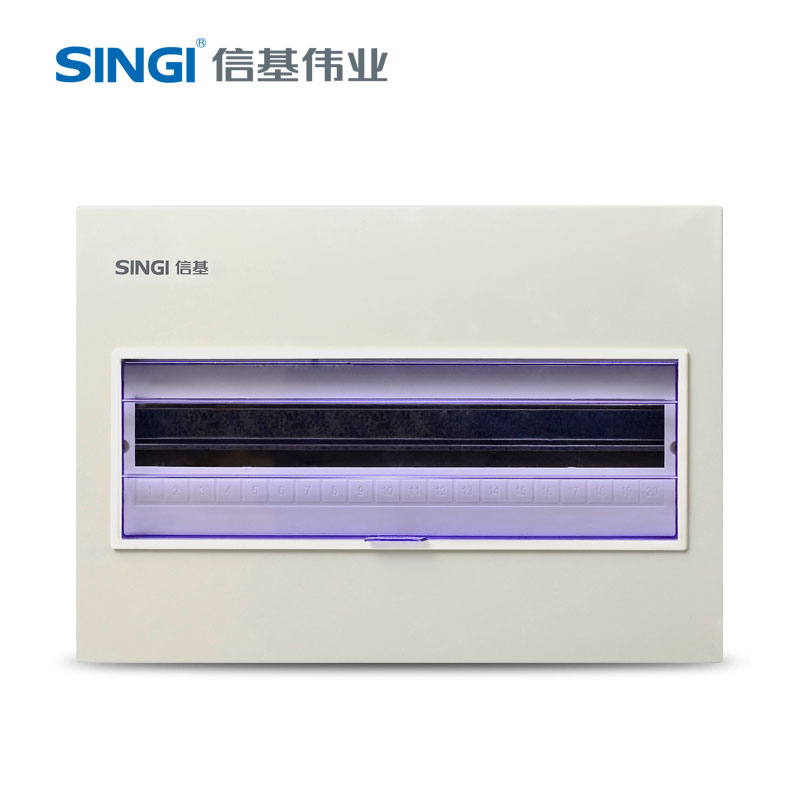
The PZ30 distribution box won on three criteria. It uses a standard 35 mm DIN rail with a modular layout that accepts MCBs, RCBOs, and terminal blocks without custom drilling. The enclosure has separate neutral and earth bars, which simplified fault tracing. And the box is available in 4 to 36 ways with a powder-coated steel body rated for industrial environments. The plant ordered 18 PZ30 boxes: 12 for the new line and 6 to replace the oldest existing panels.
Compared with the alternatives, the PZ30 distribution box reduced panel assembly time by using pre-punched cable entries and removable gland plates. The transparent door allowed visual inspection without opening the enclosure, which improved safety during troubleshooting. The box also stacked on a 300 mm wall bracket, cutting the required wall footprint by 22% compared with the old panels.
The project ran for nine weeks from approval to commissioning. The plant followed four main steps.
One typical difficulty appeared during installation. The plant's existing cable trays entered the electrical room at a height that conflicted with the top cable entry of the first four PZ30 boxes. The team rotated the removable gland plate to the bottom entry position and re-routed the cables through a short 200 mm chase. That change required 30 minutes per box, not the full day that would have been needed with a fixed-entry enclosure.
Six months after commissioning, the plant measured four results against its baseline.
The second production line started on schedule. Changeover time between packaging runs improved by 8% because the electrical team could isolate individual circuits faster and reset tripped breakers without opening the enclosure. The plant also avoided a $22,000 contractor quote for a custom panel expansion.
"The PZ30 boxes gave us a standard layout across the whole plant," said the plant's facilities engineer. "My technicians do not need to learn a different panel every time they open a door. The separate neutral and earth bars alone cut our troubleshooting time by half. We should have standardized on these enclosures years ago."
Three lessons from this project apply to other mid-sized manufacturers facing distribution panel constraints.
Industry references: Zhou L, Li H, Zhang X. Arc Fault Detection Technology in Low-Volt-level Distribution Systems: A Review. IEEE Transactions on Power Delivery, 2022, 37(4): 2789-2801. Chen G, Mou X. Study on the coordination between MCB and RCBO in low-volt-level power distribution systems. Electrical Engineering, 2022, 104(3): 1823-1835.