EMAIL US:salesmanager@singi.com
- All
- Product Name
- Product Keyword
- Product Model
- Product Summary
- Product Description
- Multi Field Search


Views: 12 Author: Mark Zhang Publish Time: 2026-10-27 Origin: 本站
The GNB60 Flush Mounted Transparent Cover from SINGI is a front protection cover for distribution boxes that keeps breaker toggles visible while shielding the interior from dust, moisture, and accidental contact. It sits level with the finished wall surface, so a consumer unit stays protected without adding bulk to a corridor or utility room. Engineers and buyers can review the full distribution box range at singi.com and compare cover options against project requirements before ordering.
Contents
Article Outline
The GNB60 Flush Mounted Transparent Cover is a front panel that closes over the breaker row of a distribution box. The window is clear polycarbonate, so an operator can read the position of every toggle without opening the enclosure. The frame sits level with the plaster or tile finish, which keeps the box face flat against the wall instead of protruding into a walkway.
Three jobs sit behind that design:
Distribution boxes in apartments, offices, clinics, and small workshops sit in corridors where space is tight. A flush cover solves the protection problem without a projecting door that blocks movement or catches clothing.
Low-volt-level assemblies are specified against accidental contact and against environmental ingress. IEC 61439-3 sets requirements for distribution boards used in domestic and similar installations, including protection against contact with live parts and mechanical robustness of enclosures. A front cover forms part of that protection strategy. IEC 60529 defines the IP code that describes how well the enclosure resists dust and water, and the cover interface is where most ingress happens.
Practical reasons carry equal weight:
A transparent cover answers all four. The SINGI GNB60 Flush Mounted Transparent Cover keeps the breaker row readable while holding the interior closed, so inspection and protection stop competing with each other.
Specification note: the IP rating of a distribution box applies to the complete assembly, not to the box alone. A cover with a poor gasket fit or a warped frame can pull a stated IP54 assembly down to IP40 in service. Check the seal at the frame edge, not only the rating on the datasheet.
Flush mounting shifts work from the electrician to the first fix and the finishing trades. Five items decide whether the result looks clean:
Retrofit projects need the same checks plus one more: existing recess depth. A shallow cavity limits box choice, and the cover must still close without pressing on breaker toggles.
Transparent covers fail in predictable ways: yellowing under sunlight, cracking at the hinge, and warping near heat sources. Material choice prevents most of it.
The GNB60 Flush Mounted Transparent Cover from SINGI targets these points : a rigid transparent front, a frame designed for a level finish, and a closure that stays shut under normal site contact.
Buyers who compare covers on price alone miss the installation and maintenance cost that follows. Use a function-based comparison instead. The table below sets the common options side by side.
| Cover type | Visibility of breakers | Protection against dust and spray | Wall projection | Best fit |
|---|---|---|---|---|
| Flush mounted transparent cover (GNB60) | Full, without opening | Good with a continuous gasket | Level with the finish | Corridors, apartments, offices, clinics |
| Surface mounted transparent cover | Full, without opening | Good | Projects from the wall | Retrofit where the wall cannot be chased |
| Opaque plastic door | None, must be opened | Good | Low to moderate | Utility rooms with restricted access |
| Metal door with lock | None, must be opened | High | Moderate to high | Industrial areas with tamper risk |
| No cover, breakers exposed | Full | None | None | Not recommended for occupied buildings |
Apply the same logic to suppliers. Ask for the cutout drawing, the gasket specification, and the hinge cycle figure. A supplier who can send a dimensioned drawing in one reply is easier to work with than one who sends a photo and a price.
Installation follows a short sequence. Set the box plumb in the recess, confirm the front edge aligns with the finished wall line, then fix the frame. Fit the gasket before the cover goes on, and check that the latch engages without force. Test the hinge through a full swing; a binding hinge stresses the window corner over time.
Maintenance is basic but should be written into the site routine:
Spare hinges and gaskets matter for multi-building portfolios. A cover that cannot be serviced becomes a cover that gets removed, and the protection disappears with it.
Distribution box accessories are bought in repeat orders across many sites. Consistency between batches decides whether the second delivery fits the first cutout. Look for stable tooling, controlled material grade, and documented dimensions. Samples help: a physical cover shows frame overlap, gasket thickness, and latch feel in a way a datasheet cannot.
SINGI supplies distribution box components with matching documentation and consistent batch dimensions. The GNB60 Flush Mounted Transparent Cover fits that supply pattern, so contractors can repeat the same specification across phases of a project without reworking cutouts. Buyers comparing options can request amperage details through the GNB60 product page.
Not when the window is polycarbonate. Polycarbonate holds impact strength well and resists cracking better than brittle styrene-based plastics. The failure mode to watch is UV yellowing, which comes from missing stabilizers than from transparency itself.
The assembly rating depends on the whole enclosure. The cover contributes through gasket compression and frame flatness. A warped frame or a pinched gasket creates a gap, and that gap sets ingress level in service.
It depends on the recess depth and cutout size of the existing installation. Measure the cavity, compare it with the frame drawing, and confirm there is clearance behind the cover for breaker toggles and cable bends before ordering.
Unprotected breakers collect dust and invite accidental operation or tampering. In occupied buildings, an open box also exposes occupants to live parts. A transparent cover keeps the breakers readable while keeping the interior closed.
Ask for the dimensioned frame drawing, the gasket specification, the material grade, and the glow-wire test result. For multi-phase projects, request a sample from the amperage production batch and check it against the installed cutout.
Cover choice belongs in the first fix, not the final inspection. Confirm recess depth, cutout tolerance, and gasket quality while the wall is still open, and the finished installation stays level, protected, and easy to inspect.
Review the GNB60 Flush Mounted Transparent Cover from SINGI and the wider distribution box range to match the cover to your project specification.
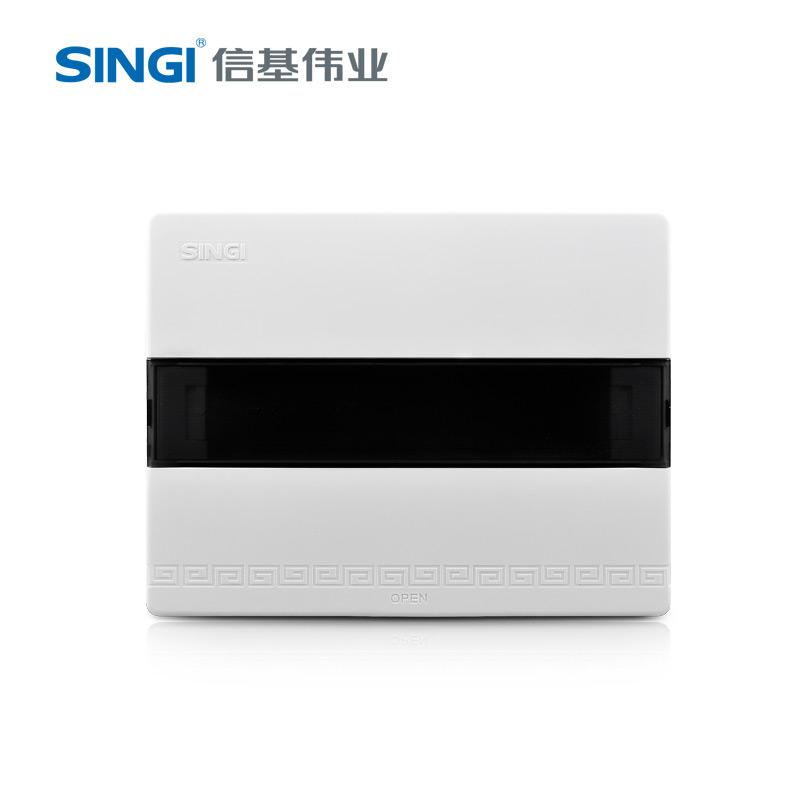
GNB60 Flush Mounted Transparent Cover — SINGI
[1] IEC 61439-3. Low-volt-level switchgear and controlgear assemblies — Part 3: Distribution boards intended to be operated by ordinary persons [S]. 2012.
[2] IEC 60529. Degrees of protection provided by enclosures (IP Code) [S]. 2013.
[3] IEC 60695-11-10. Fire hazard testing — Part 11-10: Test flames — 50 W horizontal and vertical flame test methods [S]. 2013.