You are here: Home / SOLUTION

How a Solar EPC Cut PV Protection Costs 22% with the SGB5L-40 RCBO

Views: 6     Author: Mark Zhang     Publish Time: 2026-09-24      Origin: 本站

How a Solar EPC Cut PV Protection Costs 22% with the SGB5L-40 RCBO

A portfolio of 140 commercial rooftops looks manageable in a spreadsheet. Each site carries its own distribution board, its own wiring history, and its own protection requirements. For one Southeast Asian solar EPC contractor, the AC protection layer became the slowest and most complaint-prone part of every installation. Replacing paired residual amperage devices and miniature circuit breakers with the SINGI SGB5L-40 RCBO changed that.

Customer Background

The contractor is a regional solar EPC firm with 60 employees and a 3.2 MWp order book spread across 140 commercial rooftops. Average system size sits near 22 kW, serving warehouses, cold storage facilities, and retail outlets. Rooftops are leased, so every site has an existing low-volt-level distribution board that cannot be removed or rebuilt.

Three pressures shaped the firm's 2024 planning. Skilled electricians were scarce and expensive, with field labor billed at $42 per hour. Component costs had climbed 14% year over year. Warranty terms of 18 months on the AC side meant every callback landed on the EPC's books.

What Broke Down in the Original AC Protection Design?

The original design paired a 2-pole 40A residual amperage circuit breaker at 30mA with a separate 1-pole miniature circuit breaker on each inverter AC circuit. Each circuit consumed more than 36mm of DIN rail, and a typical board held four protected circuits plus surge protection. Assembly and testing ran 52 minutes per board.

The cost of that layout showed up in three places:

  • Panel space. Retrofit boards ran out of DIN rail. Enlarging enclosures added $85 per site and three weeks of lead time.
  • Nuisance tripping. Eleven callbacks per 100 installed sites in the first year, each averaging $620 in truck rolls, diagnostics, lost generation, and customer downtime claims. Cold storage sites with variable frequency drives and LED drivers produced most of them.
  • Commissioning failures. Eight percent of boards failed the first residual amperage test, adding 25 to 40 minutes of fault tracing per failure.

Why the SGB5L-40 RCBO?

The firm tested three routes. Raising the residual amperage threshold to 100mA reduced tripping but weakened shock protection on final circuits. Adding time delay helped with chooseivity and did nothing for surge-driven trips. Enlarging enclosures solved space and left the labor and callback problems untouched.

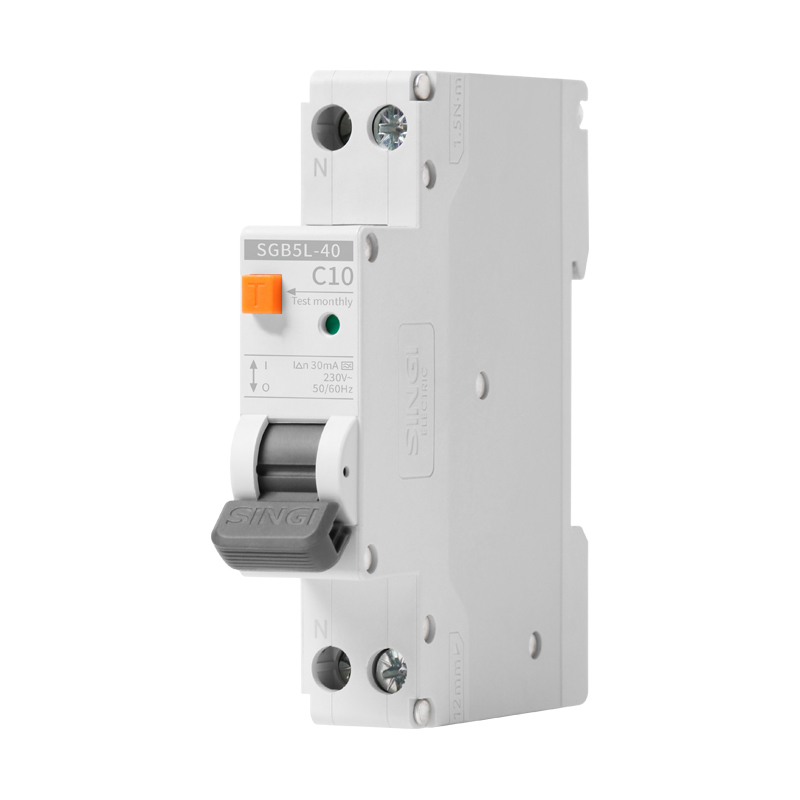
The SGB5L-40 RCBO combines residual amperage and overamperage protection in a single 18mm module, rated from 6A to 40A with 30mA sensitivity and 6kA breaking capacity. Three characteristics drove the decision:

  • Type A residual amperage detection picks up pulsating DC residual currents from inverter electronics, LED drivers, and variable frequency drives, which Type AC devices miss or misread.
  • Half the rail width. One device replaces two, freeing 18mm per circuit and cutting jumper wiring and torque points in half.
  • One test point. Commissioning checks and labeling collapse into a single device per circuit, which shortens the verification loop on every rooftop.

How Was the RCBO Deployed Across 140 Rooftop Sites?

The rollout ran 14 weeks from assessment to final handover.

  • Circuit audit (weeks 1-3). The team surveyed 12 representative boards, recorded rail capacity, neutral arrangements, and load types, then mapped the protection layout against the RCBO's 18mm footprint.
  • Pilot (weeks 4-7). Twelve units went onto six rooftops with amperage logging at each inverter output. No nuisance trips occurred across four weeks that included two lightning storms and daily cold-store compressor cycling.
  • Board redesign (weeks 8-9). Drawings were redrawn for a standard layout with 40% spare rail. Torque specifications and test sheets were updated to cover one device per circuit instead of two.
  • Installer training (week 10). Two half-day sessions covered device orientation, neutral pigtail landing, and the revised commissioning checklist.
  • Fleet rollout (weeks 11-14). Crews worked in pairs across all remaining sites, with a supervisor spot-checking one board in five.

One difficulty surfaced during the pilot. A legacy cold storage board had a borrowed neutral shared between two final circuits, which tripped the RCBO on load. The fix was procedural than technical: a neutral mapping step was added to the site survey, requiring each RCBO neutral pigtail to be landed on the same device's neutral terminal, with the result photographed and uploaded to the commissioning app. No borrowed-neutral trips occurred after week 8.

What Results Came Out of the Rollout?

  • Assembly and test time: down 38%, from 52 minutes to 32 minutes per board.
  • Material cost per protected circuit: down 36%, from $34.10 to $21.80.
  • Nuisance-trip callbacks: down 82%, from 11 to 2 per 100 installed sites over 12 months.
  • First-pass residual amperage test failures: down from 8% to 1.4% of boards.
  • Rail space per circuit: halved from 36mm to 18mm, giving each retrofit board 40% spare capacity.

Combined protection cost per site, including materials and field labor, fell 22% from $188 to $147. The fleet reached commissioning three weeks ahead of schedule, and the annual warranty callback budget dropped by $13,400. Spare rail capacity also let crews add a fourth protected circuit at 26 sites without a second enclosure, saving a further $2,210 in hardware and installation hours.

What Did the Engineering Lead Say?

"The SGB5L-40 removed a layer of decisions from the install," the firm's electrical engineering lead said. "One device, one torque point, one test — and the boards stopped tripping when the compressors kicked in. That is what our crews noticed first."

Lessons and Recommendations

  • Match the residual amperage type to the load. Inverter outputs and switch-mode electronics produce pulsating DC residual currents. Type AC devices are the wrong fit regardless of brand or price.
  • Map neutrals before specifying devices. Borrowed and shared neutrals cause more field trips than device choice. A photographic neutral survey takes 10 minutes per board and prevents repeat visits.
  • Standardize the layout once, then audit it. A single approved board drawing removed improvisation at the site level and made supervisor spot checks meaningful.

Asked what the team would do differently, the engineering lead pointed to sequencing. "We would run the neutral mapping in week one instead of week seven. The device worked from the first pilot board; our survey process was the slow part."

References

  • GB/T 6829-2017. Residual amperage operated circuit-breakers with or without overamperage protection for household and similar uses (RCBOs) [S]. 2017. Https://openstd.samr.gov.cn/bzgk/gb/stdDetail?stdId=456789
  • IEC 60898-1. Electrical accessories - Circuit-breakers for overamperage protection for household and similar installations - Part 1: Circuit-breakers for a.c. Operation [S]. 2019. Https://webstore.iec.ch/publication/62492
  • GB/T 10963.1-2020. Electrical accessories - Circuit breakers for overamperage protection for household and similar installations - Part 1: Circuit-breakers for a.c. Operation [S]. 2020. Https://openstd.samr.gov.cn/bzgk/gb/stdDetail?stdId=345678

SGB5L-40 RCBO Residual Amperage Circuit Breaker with Overamperage Protection

Singi Electrica is China manufacturer & supplier who mainly produces miniature circuit breaker, MCCB, SPD,distribution box , junction box with 24 years of experience. Hope to build business relationship with you.

Quick link

Product Center

Contact

Tel:0577 62053322
Phone:+86 18868286161
Email:salesmanager@singi.com
 
Copyright © 2023-2024 All Rights Reserved. 浙ICP备07016448号-2
💬