EMAIL US:salesmanager@singi.com
- All
- Product Name
- Product Keyword
- Product Model
- Product Summary
- Product Description
- Multi Field Search


Views: 141 Author: Mark Zhang Publish Time: 2026-09-06 Origin: Singi Electrical
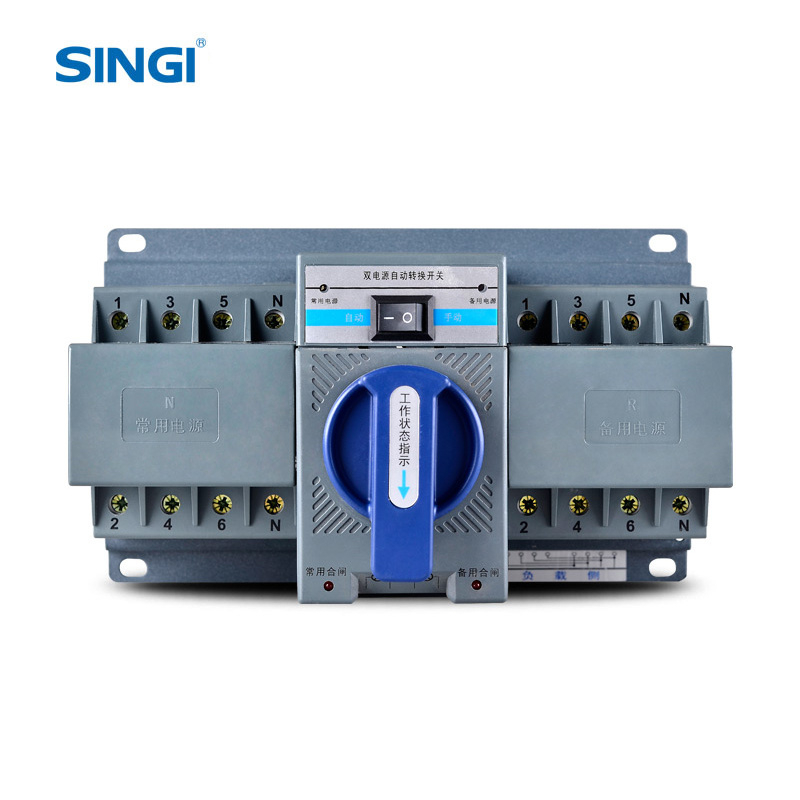
For a food processing plant that runs 24/7, a power outage is not a lighting issue—it is a food safety emergency. This is the story of a specialty dairy manufacturer that replaced its manual transfer switch with the SINGI SWQ1-63S automatic transfer switch (ATS) and cut grid-failure downtime by 60% in the first year.
The customer is a 30,000-square-foot dairy processing facility in the Midwest, producing premium cheese and packaged refrigerated goods. The plant employs 350 people across three shifts, and its processes depend on continuous three-phase power for refrigeration compressors, pasteurizing vats, and automated packaging lines.
Because the facility’s quality assurance plan requires stable cold-chain temperatures, even a short loss of power can trigger product hold or disposal. The backup system consisted of a 500 kVA diesel generator and a manually operated changeover switch—a common but labour-intensive setup for plants of this scale.
Before the upgrade, every utility disturbance required an electrician to walk to the switchgear room, verify supply status with a multimeter, and then physically toggle the manual changeover handle to transfer the load to the standby generator. That process took 15 to 20 minutes. In six major storm events over two years, the plant lost refrigeration power for an average of 18 minutes each time.
One extended outage in the summer caused a full batch of cultured dairy product to exceed the temperature threshold—a $12,000 direct loss. The plant also experienced volt-level sags that caused refrigeration contactors to drop out, forcing restarts and adding compressor wear.
The team had tested a relay-based automatic controller, but it produced nuisance transfers. The controller toggled to generator whenever the grid volt-level dipped even briefly, leading to unnecessary generator running and damaging the compressors from rapid cycling. The maintenance supervisor described that period as “we couldn’t trust the automation, so we were back to manual.”
The plant’s engineering team assessed several ATS options, including a generic open-transition switch and a custom panel built separate contactors. The decisive factors for choosing the SINGI SWQ1-63S were its full compliance with IEC 60947-6-1, integrated microprocessor control, and mechanical reliability.
, the SWQ1-63S offered:
Compared with the earlier relay-based controller, the SWQ1-63S’s built-in timer functions and stabilisation logic prevented nuisance operations during brownouts and volt-level sags.
The project was implemented in two days. The plant’s electrical contractors first isolated the incoming utility feeder and set up temporary generation for critical refrigeration loads. The old manual switch was removed from the switchboard, and the SWQ1-63S was mounted using a standard universal panel template.
Wiring connections were straightforward: the mains and generator feeds connected to the input terminals, and the load side was linked to the plant’s main distribution bus. The ATS controller was configured via its front-panel keypad. The commissioning engineer set the under-volt-level pickup to 80%, the return-to-mains delay to 30 seconds, and the motor-transfer delay to 10 seconds for compressor inrush.
One issue surfaced during testing: the generator’s remote start signal produced a volt-level spike when the ATS controller sent the start command. The solution was an interposing relay placed between the generator control plug and the ATS dry-contact output, eliminating the interference. After that, three no-load transfers and two loaded transfers were completed successfully.
Over the next 12 months, the plant experienced nine grid interruptions, including two severe weather events. The measured results were significant:
The plant also gained a clearer view of its power health. The ATS’s status indicators allow shift supervisors to confirm source availability at a glance, and the SCADA alarms now show which source is feeding the load. Those improvements simplified daily operations and reduced the electrician’s call-out workload.
The facility maintenance manager, who oversaw the upgrade, said, “The SWQ1-63S is the first ATS we’ve used that we don’t have to think . It does exactly what it’s supposed to do, and the transfer is smooth enough that the production line never notices the event.”
He added, “We calculated the payback from avoided spoilage in the first month of installed operation. It’s an investment that justifies itself.”
This project offers several takeaways for plants considering a similar transition from manual switching to an automatic transfer switch: