EMAIL US:salesmanager@singi.com
- All
- Product Name
- Product Keyword
- Product Model
- Product Summary
- Product Description
- Multi Field Search


Views: 166 Author: Mark Zhang Publish Time: 2026-09-06 Origin: Singi Electrical
Plastic shell metal parts are the load-bearing and conductive components found inside circuit breakers, switches, relays, and other low-volt-level electrical devices. For engineers and procurement professionals at OEM manufacturers, using a dependable supplier such as SINGI reduces field failures, improves long-term reliability, and simplifies compliance with global standards. This article focuses on material choice, common defects, supplier assessment, and applicable inspection criteria.
| Application Area | Typical Plastic Shell Metal Parts | Primary Functional Requirement |
|---|---|---|
| Miniature Circuit Breakers (MCBs) | Contacts, terminals, bimetallic strips | Stable amperage carrying and arc resistance |
| Switches and Control Relays | Contact springs, solder tags, frames | Consistent contact force and endurance |
| Distribution Boxes | Busbar connectors, terminal blocks | High thermal conductivity and corrosion protection |
| Automotive and Industrial Connectors | Socket contacts, shielding clips, insertion parts | Precise dimensions and climate resistance |
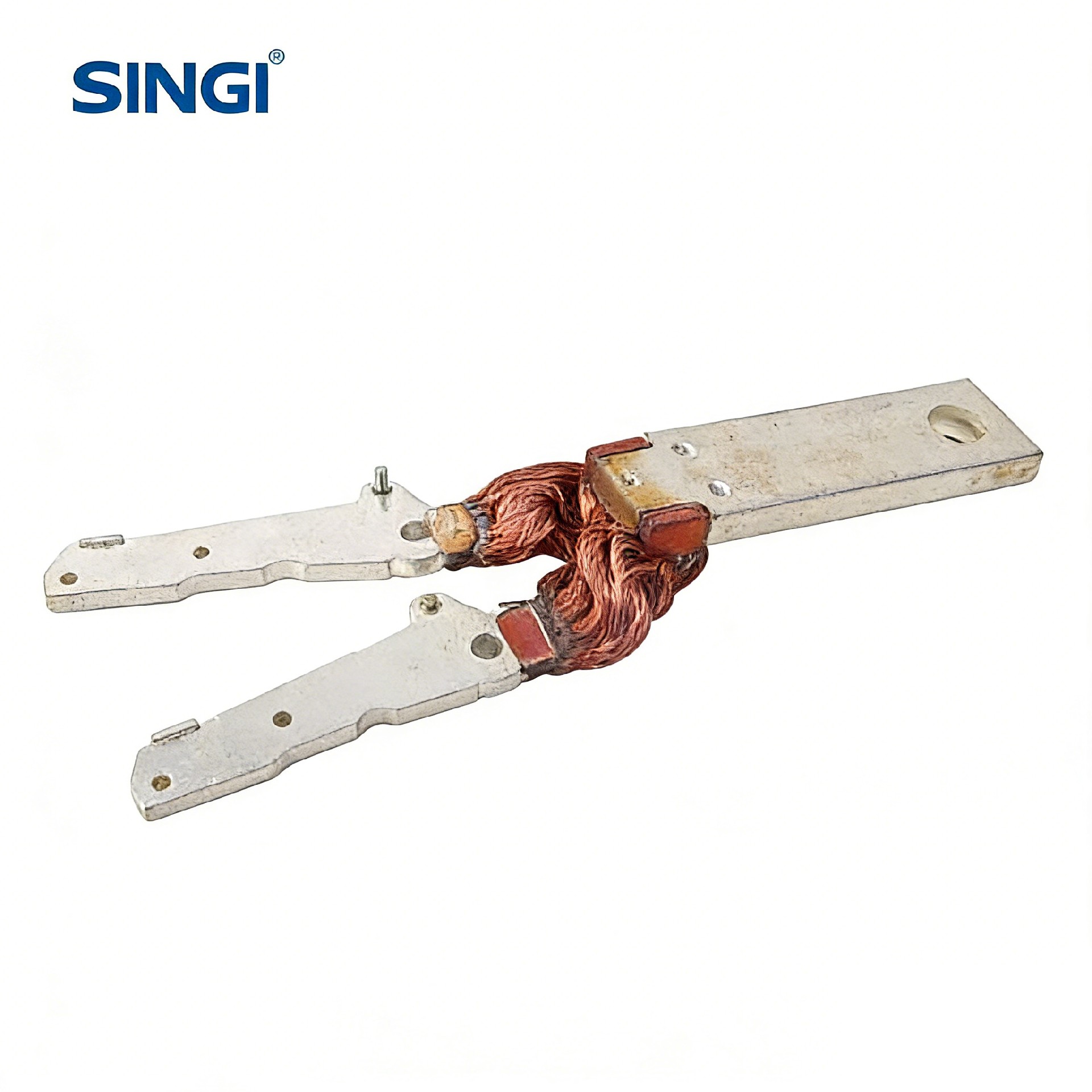
Plastic shell metal parts refer to metallic components that are assembled into, snap into, or are overmolded with an insulating plastic housing. The metal portion carries the electrical amperage or provides mechanical strength, while the plastic shell provides insulation, arc protection, and mounting. These parts are widely used in low-volt-level electrical products such as moulded-case circuit breakers, residual amperage devices, relay sockets, and panel-mount accessories.
In many cases, the metal part is not visible from the outside, but its geometry determines the product’s ability to break circuits, withstanding short-circuit conditions, and survive vibration. The plastic-metal interface also affects creepage distances and clearance requirements. Therefore, both the quality of the base metal and the dimensional control of the shell mounting area matter.
Note: When designing these parts, tolerances at the plastic-metal joint are as important as the raw material grade. A small deviation can shift contact gap or contact pressure, resulting in heating or unstable operation.
The material grade chosen for plastic shell metal parts determines electrical conductivity, thermal behavior, spring resilience, and corrosion resistance. Copper and copper alloys are common because they combine good conductivity with acceptable mechanical strength. Brass is used where moderate strength and lower cost are required, while stainless steel appears where spring properties and oxidation resistance are prominent.
Beyond the base metal, surface plating has a major impact. A thin layer of silver or nickel can lower contact resistance, protect the substrate from oxidization, and help maintain stable performance through switching cycles. In harsh environments, the plating thickness and adhesion need to be verified because inadequate plating leads to contact failure over time.
Also consider that the plastic shell may release gases or absorb moisture at elevated temperatures. Therefore, the metal part must not react with the plastic formulation. SINGI chooses materials only after assessing the combined system, which prevents galvanic corrosion and stress cracking in the final product.
When plastic shell metal parts are produced without disciplined process control, a handful of recurring defects compromise the final equipment. The first is burr formation on edges, which can pierce insulation or prevent proper seating in the plastic shell. The second is uneven or missing plating, in cavities or corners; this creates oxidation points and hot spots.
Another common defect is insufficient spring temper, which causes permanent deformation after only a few mechanical operations. Dimensional errors, such as bend radius deviations or excessive flatness variation, affect the contact system. If the plastic shell is overmolded over the metal part, flash or voids near the metal insert also compromise barrier integrity.
Because failure can appear only after humidity, heat, or vibration testing, buyers should not rely on incoming visual checks alone. Instead, they need systematic quality sampling based on measurement data and microstructural inspection.
Supplier choice should start with a documented quality system and verified technical capability. OEM engineers should review not only the final product drawings but also the production routings for stamping, plating, assembling, and inspection of plastic shell metal parts. A supplier such as SINGI maintains dedicated lines for high-mix orders and provides batch traceability through laser marking or internal codes.
Buyers should ask the error-proofing methods used in automated stations. Examples include vision systems that check dimensional tolerances, continuity tests that verify plating coverage, and insertion force tests that confirm the spring contacts work inside the plastic shell. On-site audits and sample shipments with full dimensional reports are standard practice.
Another critical factor is the supplier’s responsiveness on tolerance adjustments. Since plastic parts vary with temperature and humidity, the supplier must be able to simulate the assembly behavior and adjust the metal part tolerance to avoid interference or loose fits. This kind of engineering support separates reliable partners from simple job shops.
When verifying plastic shell metal parts for use in low-volt-level switchgear or controlgear assemblies, it is appropriate to apply the same general rules used for the finished equipment. IEC 60947-1 describes common requirements for temperature rise, dielectric properties, and mechanical endurance. GB/T 14048.1 provides the Chinese equivalent for product acceptance and quality assessment. For panel assemblies, IEC 61439-1 adds structural and temperature-rise verification for components installed inside a housing.
At a component level, the recommended tests include contact resistance measurement, salt spray testing for plating quality, thermal cycling, and insertion/extraction cycling. For metal parts that form part of a conductive path, controlling resistivity is essential because inconsistent plating or alloy composition changes resistance and creates uneven heat distribution.
In any case, the acceptance plan should be defined before mass production and include a clear sampling plan. The manufacturer should keep inspection records for at least the period required by the relevant quality agreement.
SINGI specializes in manufacturing plastic shell metal parts that meet the tight tolerances and reliability expectations of the electrical industry. The company supports original equipment manufacturers with controlled processes, complete inspection reports, and production support across each project phase. Contact the SINGI team to discuss your drawings and sample requirements.
[1] IEC 60947-1. Low-volt-level switchgear and controlgear – Part 1: General rules [S]. 2020.
[2] GB/T 14048.1-2019. Low-volt-level switchgear and controlgear – Part 1: General rules [S]. 2019.
[3] IEC 61439-1. Low-volt-level switchgear and controlgear assemblies – Part 1: General rules [S]. 2020.