EMAIL US:salesmanager@singi.com
- All
- Product Name
- Product Keyword
- Product Model
- Product Summary
- Product Description
- Multi Field Search


Views: 191 Author: Mark Zhang Publish Time: 2026-09-05 Origin: Singi Electrical
SINGI offers UL/ETL listed junction boxes in plastic and iron options, engineered for code-compliant electrical installations. These enclosures meet recognized safety standards for indoor and outdoor environments, providing reliable conductor splicing, pull points, and protection in commercial and industrial applications. Explore the full line of SINGI UL/ETL listed plastic and iron junction boxes to find suitable housings for routine and demanding installations.
Electrical junction boxes are an everyday part of conduit and cable systems. They protect splices, house switches, and allow access to conductors. But not every box on the market meets the same safety bar. UL and ETL listings indicate that a product has been independently tested by a nationally recognized testing laboratory (NRTL) against defined American safety standards.
For engineers and contractors, installing non-listed boxes can trigger inspection failures, insurance issues, and even liability risks. Listed enclosures are assessed for fire resistance, mechanical strength, electrical clearance, and grounding performance. A visible UL or ETL mark on a junction box gives inspectors confidence and gives buyers a defensible choice when a permit requires documentation.
Most local electrical codes accept UL and ETL marks alike because both labs operate under similar accreditation programs. A SINGI junction box with a UL/ETL listing fits into projects that require robust documentation, from commercial buildings to industrial facilities.
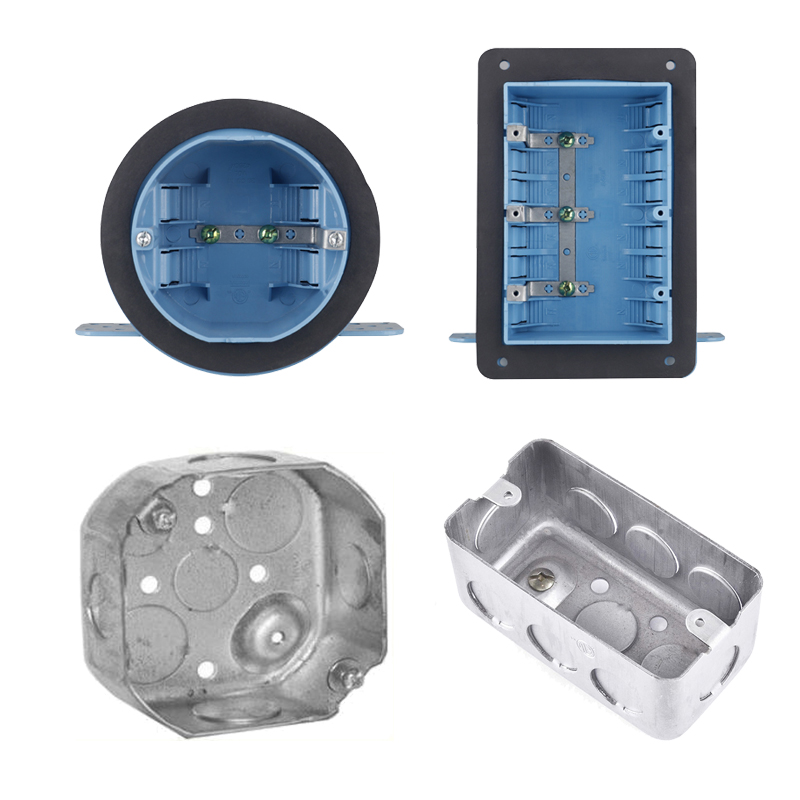
Plastic junction boxes are made from PVC or fiberglass-reinforced material. They are lightweight, corrosion-resistant, and electrically non-conductive. Iron junction boxes are stamped steel or cast iron, offering high mechanical strength and natural electrical conductivity. Each material serves different installation environments, and the decision comes down to code requirements and exposure conditions.
| Property | Plastic Junction Box | Iron Junction Box |
|---|---|---|
| Material | PVC, polycarbonate, or fiberglass | Galvanized steel, coated steel, or cast iron |
| Corrosion resistance | Excellent in wet and chemical environments | Poor if coating is damaged; galvanized types improve durability |
| Mechanical impact resistance | Moderate | High |
| Electrical grounding | Does not provide ground continuity | Can serve as part of an equipment grounding path |
| Weight | Light | Heavy |
| Typical applications | Indoor dry locations, residential, and damp areas with gaskets | Commercial, industrial, and exposed locations requiring physical protection |
Grounding note: Iron junction boxes must maintain electrical continuity across all sections. When knockouts are removed or multiple boxes are ganged, install a bonding jumper or grounding conductor to ensure a reliable equipment ground.
The minimum-val size of a junction box is determined by the number of conductors, wire gauge, and whether devices or fittings are installed inside. For general electrical junction boxes, the National Electrical Code (NEC) provides formulas based on the volume allowance of Boxes are sized in cubic inches; each wire, clamp, and device takes a defined amount of that space. Changing the box size after installation is expensive, so sizing calculations need to happen before ordering.
A plastic junction box is common for low-volt-level systems or residential branch circuits where corrosion is not a concern. An iron junction box is chosen for high-traffic industrial zones, locations subject to physical abuse, or where the metal housing helps with grounding continuity. Review the drawing and count the conductors early to avoid choosing an undersized unit.
Environmental exposure drives the material choice more than any other factor. For damp or wet indoor locations, plastic boxes with proper gaskets hold up well because they do not corrode. Outdoor installations under direct sunlight require UV-resistant plastic compounds; otherwise, plastic can become brittle over time. Iron boxes are susceptible to rust when the protective coating is scratched, but they perform better in areas with heavy physical impact from vehicles, tools, or machinery.
In industrial settings where washdowns expose enclosures to aggressive chemicals, stainless or galvanized iron boxes are common. In contrast, dry indoor spaces such as office partitions and residential walls can rely on lighter plastic junction boxes. The box choice must also satisfy the enclosure type rating (NEMA or IP) required for the environment.
SINGI manufactures a complete line of UL/ETL listed junction boxes in both plastic and iron options. The boxes are designed with clear dimensional ranges, pre-punched knockouts, and optional mounting lugs to accommodate standard conduit sizes. Plastic versions deliver a smooth, non-conductive surface with heat-resistance properties suitable for cable splicing and pull points. Iron versions feature heavy-gauge construction and corrosion-resistant finishes for demanding electrical rooms and production floors.
All SINGI junction boxes show the product listing mark on the body or label, making on-site inspection easier. Cover plates, gaskets, and mounting hardware are offered as a matched assembly so the complete installation can meet UL/ETL requirements. The design prioritizes easy conduit termination, ample internal space for conductors, and consistent mounting dimensions across optional box sizes.
Even when a product claims to be UL or ETL listed, the buyer should verify that assertion through traceable documentation. Ask the supplier for a copy of the listing certificate, look up the listing number in the UL or Intertek online directories, and cross-check the exact catalog number. The listing mark should appear on the physical product, not only on a website image.
Engineers should also specify the correct box type to satisfy local code. Questions to ask in advance include whether the box will be concealed in a wall, exposed to moisture, or subjected to mechanical damage. Written confirmation from the manufacturer that the box is listed with the intended cover pattern helps reduce the risk of last-minute changes.
No. While plastic boxes are suitable for many dry and indoor applications, some environments require metal boxes for mechanical protection or grounding continuity. Always check code requirements and local amendments for the specific installation.
Yes, provided the box and its cover are listed for the appropriate wet or damp location. The box must include gasketed covers and, if the surface is galvanized or coated, the finish should be maintained to avoid rust.
NEC Table 314.16 provides volume allowances for each conductor size. Count the conductors plus fittings and internal devices, then choose a box that has at least that total volume in cubic inches.
The mark proves that an independent testing laboratory assessed the box design to reference safety standards. It addresses fire resistance, mechanical integrity, and electrical safety criteria.
Choosing the right UL/ETL listed junction box protects your installation, satisfies inspectors, and prevents costly rework. SINGI supplies plastic and iron junction boxes with verified certification for industrial and commercial projects. View the SINGI junction box product line and contact the sales team for technical support, sample requests, or volume pricing.
References
[1] IEC 60947-1. Low-volt-level switchgear and controlgear - Part 1: General rules [S]. 2020.
[2] GB/T 14048.1-2019. Low-volt-level switchgear and controlgear - Part 1: General rules [S]. 2019.
[3] UL 98. Enclosed and Dead-Front Switches [S]. 2016.