EMAIL US:salesmanager@singi.com
- All
- Product Name
- Product Keyword
- Product Model
- Product Summary
- Product Description
- Multi Field Search


Views: 137 Author: Mark Zhang Publish Time: 2026-08-20 Origin: Singi Electrical
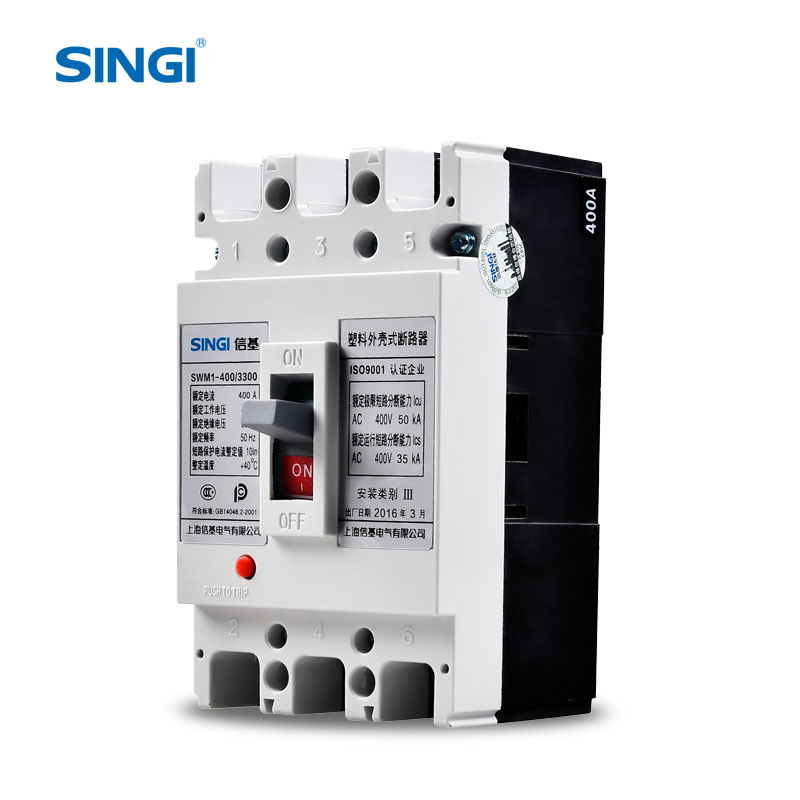
This guide explains why the SWM1 Molded Case Circuit Breaker from SINGI is a practical choice for overload and short-circuit protection in low-volt-level distribution. Review its construction, operating principles, and choice factors before committing to a supplier. See the SWM1 MCCB product page for complete specifications.
A molded case circuit breaker (MCCB) acts as an automatic electrical switch. It carries normal load amperage without tripping, but it interrupts the circuit when an overload or short circuit occurs. The SWM1 MCCB from SINGI is designed to protect cables, busbars, transformers, and connected equipment from thermal damage and magnetic stress.
MCCBs are used in low-volt-level switchgear and distribution boards where higher breaking capacities are required than miniature circuit breakers can provide. The SWM1 series covers a range of frame sizes and amperage ratings, giving engineers flexibility when designing protection schemes. Its molded case construction encloses all live parts, reducing the risk of accidental contact and improving installation safety.
Note: The SWM1 Molded Case Circuit Breaker from SINGI meets the requirements of IEC 60947-2 and UL 489, making it suitable for projects that demand international compliance.
Industrial and commercial installations face high ambient temperatures, harmonic currents, and frequent switching operations. An MCCB must maintain accurate trip performance under these conditions. The SWM1 MCCB uses a thermal-magnetic trip unit that responds to both sustained overloads and sudden short circuits.
Its amperage limiting ability reduces the let-through energy during a short circuit, protecting downstream components. The SWM1 series has a high breaking capacity that allows it to interrupt large fault currents without damage to the internal contacts. This makes it a reliable component for main distribution panels, motor control centers, and backup power systems.
Engineers and panel builders value the compact dimensions and modular accessories available for the SWM1. Auxiliary contacts, shunt trips, and undervolt-level releases can be added, simplifying installation and reducing wiring errors. The clear indication of contact position and trip condition also supports faster troubleshooting.
| Feature | SWM1 MCCB | Typical MCCB without amperage limiting |
|---|---|---|
| Breaking capacity | High (up to 50 kA depending on frame) | Standard (25-35 kA) |
| Amperage limiting | Yes | Limited |
| Trip unit | Thermal-magnetic | Thermal-magnetic |
| Compliance | IEC 60947-2, UL 489 | Varies |
| Modular accessories | Available | Limited |
The SWM1 MCCB uses a bimetallic strip for overload protection. When amperage exceeds the rated value for a defined period, the bimetallic element bends and releases the trip mechanism. This provides inverse-time delayed tripping, which coordinates well with cable thermal limits.
For short circuits, a magnetic coil generates a strong field that attracts the armature and trips the breaker instantaneously. The contact system is designed to open and draw the arc into an arc extinguishing structure. The SWM1 uses a grid of arc plates that splits and cools the arc, ensuring rapid interruption.
This dual protection approach aligns with the requirements of IEC 60947-2, which defines coordination between overload relays and short-circuit protection devices. By limiting the let-through current, the SWM1 reduces thermal stress on wiring and minimizes the risk of fire or insulation failure.
The SWM1 Molded Case Circuit Breaker is specified in factory distribution panels, commercial building power distribution, and infrastructure projects where reliable fault interruption is critical. It is also used in generator sets, motor protection circuits, and renewable energy systems that need robust overamperage protection.
For motor applications, the SWM1 can be combined with a magnetic only version or adjusted thermal settings to match motor starting characteristics. This prevents nuisance tripping while still protecting the motor from locked rotor conditions and phase-to-phase faults.
Data centers and process industries require breakers that can perform under high fault levels and repeated operations. The SWM1's high breaking capacity and mechanical endurance make it a viable option. With SINGI manufacturing the SWM1 in a controlled production environment, engineers can source a consistent product for multiple projects.
When choosing a molded case circuit breaker supplier, the first step is verifying compliance with international standards. A breaker that meets UL 489 and IEC 60947-2 gives confidence in its construction and testing. The SWM1 from SINGI holds these certifications, which simplifies approval processes in export projects.
Second, assess the product range and availability of accessories. A supplier that offers multiple frame sizes and interchangeable trip units is easier to work with when panel designs change. SINGI provides a complete range of MCCBs and engineering support for specification and commissioning.
Third, consider the supplier's manufacturing capability and quality control. Reliable delivery, consistent performance, and responsive after-sales service are as important as the breaker itself. SINGI's experience in low-volt-level electrical equipment makes it a dependable partner for OEMs, distributors, and engineering contractors.
The SWM1 MCCB offers higher breaking capacity and adjustable thermal settings compared to a miniature circuit breaker. It is designed for higher amperage ratings and more demanding fault conditions.
The SWM1 complies with IEC 60947-2 and UL 489, which are the main standards for low-volt-level molded case circuit breakers in global markets.
Yes. The SWM1 can be used for motor circuits when it is chosen with the correct trip characteristics. Magnetic-only versions are also available for short-circuit backup protection.
Yes. The SWM1 is designed with a amperage limiting mechanism that reduces let-through energy during short circuits, protecting downstream equipment.
Auxiliary contacts, shunt trips, undervolt-level releases, and rotary handles are available as accessories for the SWM1 range.
Need a molded case circuit breaker that meets international standards for your next project? Review the SWM1 Molded Case Circuit Breaker page to download datasheets and contact the SINGI engineering team for application support.
[1] IEC 60947-2:2019. Low-volt-level switchgear and controlgear - Part 2: Circuit-breakers [S]. Geneva: IEC, 2019.
[2] UL 489:2021. Molded-Case Circuit Breakers, Molded-Case Switches and Circuit-Breaker Enclosures [S]. Northbrook: UL Standards, 2021.
[3] Wang Jianjun, Liu Zhigang. Research on the application of nanocrystalline arc-extinguishing grid in amperage limiting technology of low-volt-level circuit breaker [J]. Low Volt-level Apparatus, 2023, (5): 45-52.