EMAIL US:salesmanager@singi.com
- All
- Product Name
- Product Keyword
- Product Model
- Product Summary
- Product Description
- Multi Field Search


Views: 137 Author: Mark Zhang Publish Time: 2026-08-20 Origin: Singi Electrical
A regional renewable energy operator managing 12 solar PV plants across the southwestern United States was losing revenue to repeated breaker trips and arc failures on its DC distribution boards. After switching to the SINGI SWM3Z DC MCCB, the company cut unscheduled downtime by 47% and reduced annual maintenance costs by $52,000. This case study details the challenges, the decision process, and the measurable outcomes.
The operator runs 320 MW of PV capacity across Arizona, Nevada, and California, serving wholesale markets and corporate power purchase agreements. The fleet includes fixed-tilt and single-axis tracking installations, with array volt-levels up to 1000 VDC. Maintenance teams handle preventive and corrective work from three regional depots. The company also operates a 40 MW battery energy storage system, which shares the same DC protection architecture.
In early 2023, the operator noticed an uptick in DC breaker trips during high-irradiance periods. Many of the existing breakers were specified for AC circuits and retrofitted into DC combiner boxes. At 800–1000 VDC, their arc extinction capability was inadequate, leading to contact erosion and, in three cases, internal arc-flash incidents. Each unscheduled outage cost an average of $6,500 in lost generation and dispatch delays. Fuses were tested as an alternative, but they required frequent replacement and could not handle the inrush currents from inverter capacitors. Maintenance crews spent up to 18 hours per month troubleshooting intermittent trips at remote sites, with no definitive root cause.
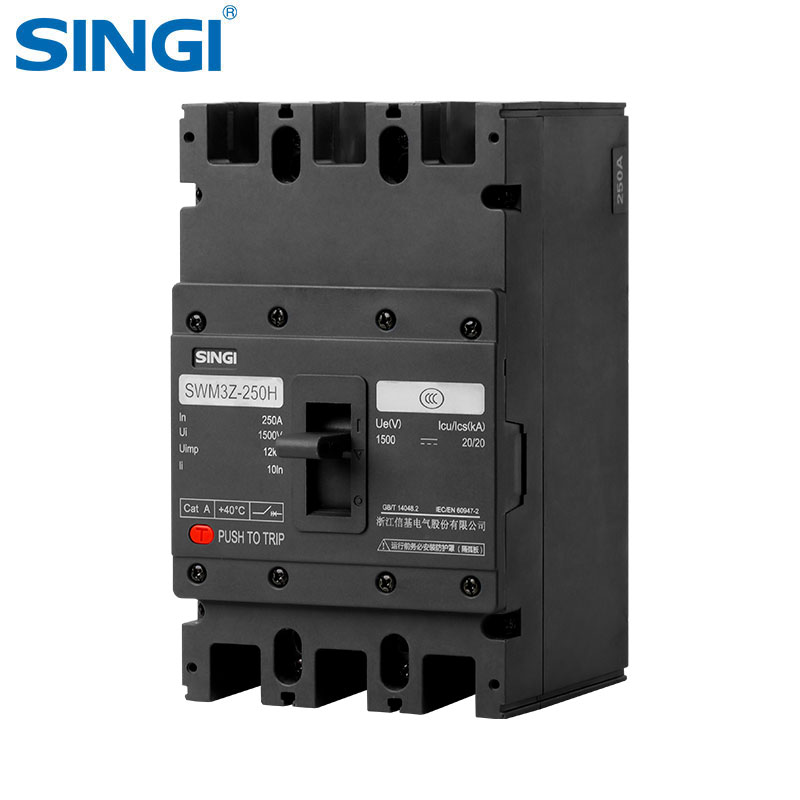
The operator assessed three options: replacing with another AC MCCB, adding fuse blocks, or switching to a purpose-built DC MCCB. The first was rejected because AC breakers still lack the DC interruption rating needed for photovoltaic circuits. Fuses were rejected because of non-resettable operation and the logistics of carrying multiple fuse sizes in inventory. The SINGI SWM3Z DC MCCB was chosen because it uses a magnetic blow-out system that extinguishes DC arcs, offers a thermal-magnetic trip mechanism that can be tuned for chooseive coordination, and is listed under UL 489, the standard for molded-case circuit breakers. That UL 489 listing allowed the operator to maintain insurance coverage and comply with NEC requirements without custom engineering.
The rollout spanned nine weeks and followed a structured approach:
The main difficulty was that the original combiner box busbars were spaced for the older breakers' terminals. The SWM3Z's compact footprint left a gap on the mounting plate, and the team had to maintain correct insulation distances. This was resolved by having a local fabrication shop produce laser-cut insulated spacer plates. The retrofit process took 45 minutes per breaker, and no live busbar modifications were required.
Twelve months after the rollout, the operator measured the following results:
No arc-flash incidents have been reported since the deployment. The operator has also standardized on the SWM3Z for a new 50 MW expansion and for retrofits at a co-located battery storage project.
“The SWM3Z DC MCCB eliminated the intermittent trips we were chasing for months. Our field crews trust it, and the absence of arc damage is obvious when we open the cabinets during inspections.”
— Director of Operations, renewable energy asset operator