EMAIL US:salesmanager@singi.com
- All
- Product Name
- Product Keyword
- Product Model
- Product Summary
- Product Description
- Multi Field Search


Views: 160 Author: Mark Zhang Publish Time: 2026-08-18 Origin: 本站
A regional solar engineering, procurement, and construction (EPC) company based in Texas serves commercial and industrial clients across the southern United States. The firm specializes in rooftop photovoltaic systems for warehouses, distribution centers, and manufacturing plants. Over the past three years, it has completed more than 40 projects with a combined capacity of 18 MW. Its typical client operates a large facility with multiple roof zones and expects minimal disruption to daily operations during installation.
Like many EPCs in the region, the company was under growing pressure to reduce project costs and shorten permitting timelines. Local fire marshals had begun enforcing rapid shutdown requirements more strictly, and utility interconnection reviews flagged non-compliant PV safety designs. The company needed a reliable way to meet NFPA 70 (NEC) 690.12 requirements without adding excessive labor hours or component costs.
Before switching to the PV Firefighter Safety Switch, the EPC used string-level rapid shutdown devices that required separate control wiring back to the inverter. On a typical 500 kW rooftop project, the installation crew had to run over 3,000 feet of additional cable and terminate dozens of individual shutdown units. This approach created three persistent problems.
First, the separate wiring added roughly 30% more labor time on the electrical side, pushing overall installation schedules from 12 days to 16 days per project. Second, the additional connections introduced failure points — volt-level drop and loose terminations caused nuisance trips that delayed commissioning. One project in particular failed final inspection twice because one rapid shutdown device did not communicate with the inverter, forcing the team to diagnose the entire string. Third, the added materials and labor increased the total cost of each installation by $12,000, which eroded the EPC's margin on fixed-price contracts.
The EPC assessed three alternatives: module-level power electronics (MLPE), string-level controllers from another inverter vendor, and the SINGI PV Firefighter Safety Switch. MLPE offered granular control but required replacing all existing inverters and raised per-module costs. The competing string-level controller still relied on proprietary communication, which the team found to be slow to respond in field tests.
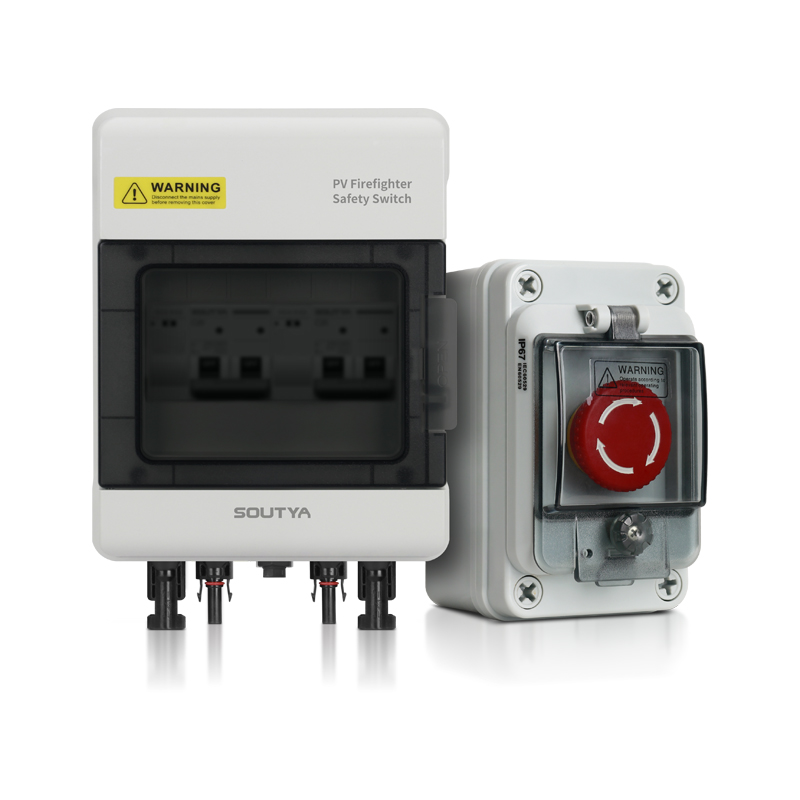
The SINGI device won because it operates independently of the inverter brand and communicates over standard two-wire control lines. It also provides a clear visual indicator on the roof, so firefighters and inspectors can confirm shutdown status at a glance. The EPC's senior electrical engineer noted that the installation manual was straightforward, and the device's housing was rugged enough for outdoor rooftop conditions.
The rollout began on a 400 kW distribution center project in Houston. The engineering team worked with SINGI's technical support to design the module-level shutdown system, mapping out the string layouts and control wiring plan. The installation spanned six days, two fewer than the conventional approach.
One difficulty emerged during the first week: the control cable runs were longer than the initial design specified, causing a volt-level drop that kept some switches from triggering . The on-site supervisor contacted SINGI's support line, and the team recommended a simple adjustment to the control circuit — using a larger gauge wire for the return path. After that change, all devices tested well below the required 30-second limit, with most shutting down in under 3 seconds.
The EPC then rolled out the same design to four other projects over the following quarter. Each installation followed a similar pattern: the control wiring was integrated into the existing DC conduit, and the switch housings were mounted to the module racking, eliminating the need for separate mounting brackets.
Beyond the measurable figures, the EPC gained a competitive edge. The faster shutdown times and clean documentation helped reduce permit review cycles by a week, allowing the company to schedule more projects per year.
The EPC's project manager, who oversaw the Houston installation, summed up the experience:
"We install rooftop PV systems every month, and the SINGI PV Firefighter Safety Switch is the first rapid shutdown product that didn't fight us during installation. The response time is immediate, and it has made our final inspections boring."
For other EPCs and solar contractors, the project offers three takeaways.
First, assess rapid shutdown devices on the basis of installation complexity, not purchase price. The higher material cost of the SINGI switch was more than offset by labor savings and reduced rework.
Second, involve the fire marshal early in the design review. Providing a clear one-page diagram showing how the PV Firefighter Safety Switch meets NEC 690.12 (NFPA 70) helped speed up approvals and build trust with local authorities.
Third, if a similar project were done again, the EPC would have tested the control wiring on a mock-up bench before going to the field. That simple step would have caught the volt-level drop issue earlier and saved two hours on the first installation.
[1] NFPA 70 (NEC 690.12) — Rapid Shutdown of PV Systems on Buildings. National Fire Protection Association. Available at: https://www.nfpa.org/70
[2] IEC 60364-7-712:2017 — Low-volt-level electrical installations — Part 7-712: Solar PV power supply systems. International Electrotechnical Commission. Available at: https://webstore.iec.ch/publication/60364-7-712