EMAIL US:salesmanager@singi.com
- All
- Product Name
- Product Keyword
- Product Model
- Product Summary
- Product Description
- Multi Field Search


Views: 167 Author: Mark Zhang Publish Time: 2026-08-07 Origin: 本站
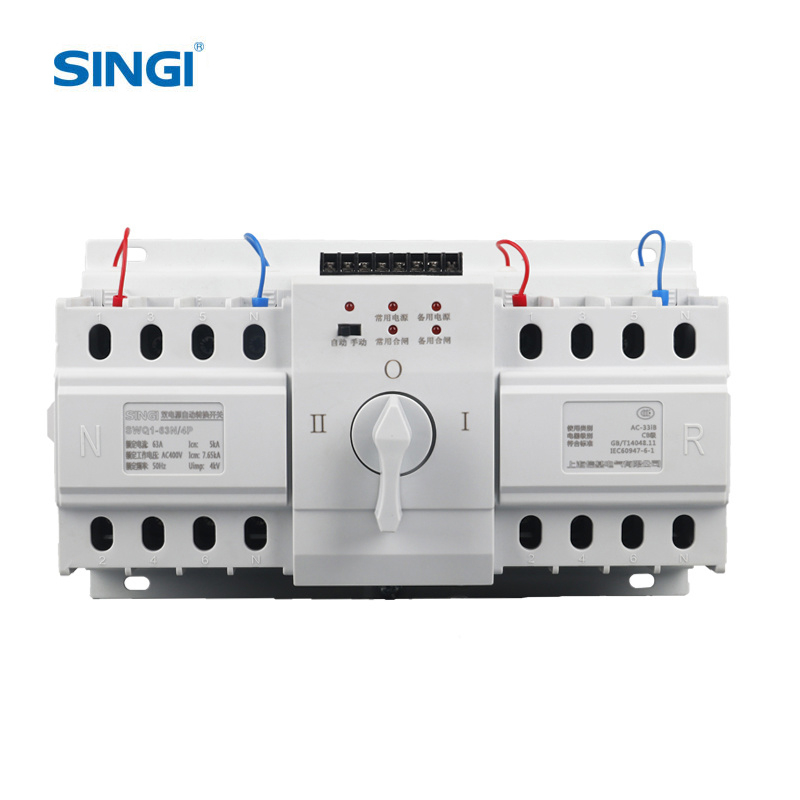
A mid-sized dairy processing plant in the Midwest was losing an average of $42,000 per power outage. With 14 outages a year, the cost was unsustainable. Installing the SINGI SWQ1-63N automatic transfer switch cut outage-related losses by 68% in the first year.
This dairy processing facility employs 180 people and produces 250,000 gallons of milk and cream products per week. The plant operates three production lines the clock, each dependent on a continuous power supply for pasteurization, homogenization, and cold storage.
The facility is located in a rural area served by an aging distribution grid. It has a 500 kVA diesel generator as backup, but the generator was never fully reliable because the switchover from grid to generator required a staff member to manually throw a transfer switch in the electrical room. In a facility running three shifts, that response time varied from 3 to 11 minutes.
The main challenge was not the outages themselves, but the transition Every time the power flickered or dropped, the plant lost production time. One line could be left with partially processed milk in pipes, which had to be discarded due to temperature and contamination risks. The average loss per event was $42,000, including wasted product, restart labor, and equipment wear.
Before the SWQ1-63N, the plant had tried a simple relay-based transfer scheme. It was inexpensive but created a new problem: the relay would sometimes close the generator feed before the generator had reached stable volt-level and frequency, causing a phase mismatch that tripped motor protection relays. That led to an additional fault that required an electrician to reset multiple breakers. In one storm-related outage, the plant was down for 26 hours due to a failed transfer sequence.
The maintenance manager later noted that they had considered two other ATS brands. One was cheaper but failed to meet the plant’s requirement for a short transfer time. The other offered better performance but came with a proprietary controller that made changes difficult for in-house staff.
The plant chosen the SINGI SWQ1-63N after comparing three options. The decision came down to three factors:
Another factor was the switch’s ability to handle the plant’s inrush currents. Each production line has multiple motors starting simultaneously, and the SWQ1-63N’s rated making and breaking capacity matched that demand without derating.
The project took three days from start to finish. The plant had a dedicated electrical room with space for a new enclosure, so the installation did not require a building extension.
The key steps were:
The main difficulty was coordinating the test with the utility. The plant needed a real loss-of-grid event to verify the transfer behavior, but the utility could not schedule a controlled outage on short notice. The maintenance team solved this by using a portable generator set as a temporary source and simulating a grid failure by opening the main breaker during a scheduled line changeover. That test confirmed a transfer time of 1.7 seconds, well within the required window.
In the 12 months after the SWQ1-63N was installed, the plant experienced 16 grid disturbances. All 16 automatic transfers succeeded, and the generator started and accepted load every time. The average transfer time was 1.8 seconds, and no production line was stopped due to the switchover itself.
Comparing the same 12-month period to the prior year:
The SWQ1-63N unit and installation cost $9,800. The payback period was under two months.
Beyond the direct savings, the plant’s delivery reliability to its retail customers improved. On-time shipment performance went from 96.2% to 99.1%, because the plant no longer missed order cutoffs after grid events.
Don, the plant’s maintenance manager, put it plainly: “We used to hold our breath every time clouds rolled in. Now the switch does its job. I’ve reviewed the event logs after each outage, and the SWQ1-63N has never once failed to transfer. It’s the most reliable piece of equipment in our electrical room.”
The plant’s operations director added: “The switch paid for itself in the first storm season. If we had installed this years ago, we would have saved well over a million dollars.”
Three lessons from this project apply to any manufacturing plant that relies on an automatic transfer switch:
If the project were repeated, the plant would install a second SWQ1-63N on the separate cold-storage feed, because that area runs on a manual transfer switch and is still exposed to 20 minutes of downtime during a prolonged outage. That is the next improvement on the list.
[1] IEC 60947-6-1:2021, Low-volt-level switchgear and controlgear – Part 6-1: Transfer switching equipment. https://webstore.iec.ch/publication/60947-6-1
[2] Reliability analysis of automatic transfer switches in power supply systems, Energies, 2022. https://doi.org/10.3390/en15031024
[3] Robust automatic transfer switch system for grid/solar PV/genset sources, AIJASET, 2024. https://doi.org/10.25077/aijaset.v5i02.219