EMAIL US:salesmanager@singi.com
- All
- Product Name
- Product Keyword
- Product Model
- Product Summary
- Product Description
- Multi Field Search


Views: 155 Author: Mark Zhang Publish Time: 2026-08-06 Origin: 本站
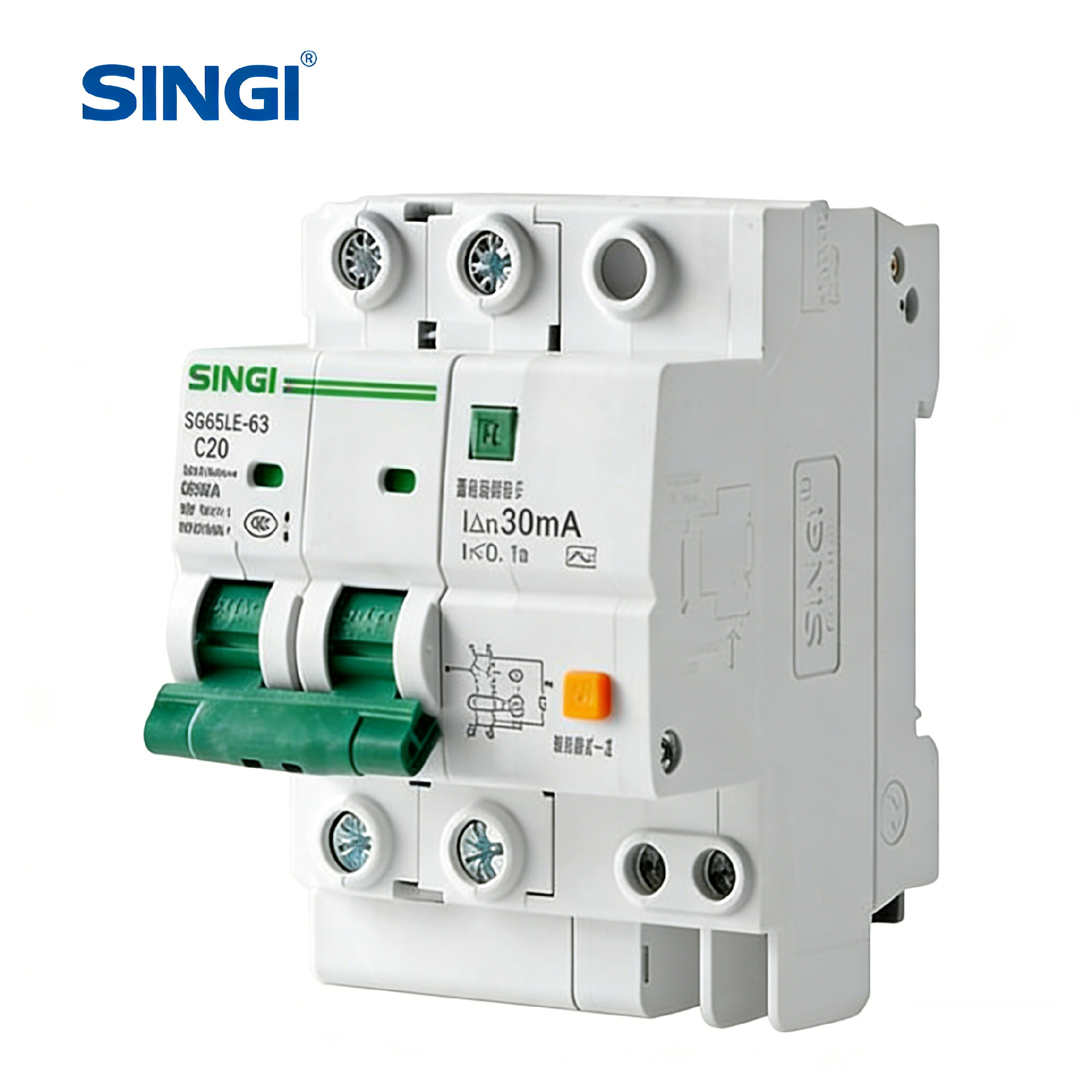
The SC65LE-63 Residual Amperage Circuit Breaker with Overamperage protection from SINGI combines leakage protection, overload protection, and short-circuit protection in a single DIN-rail module. This article explains why engineers and procurement teams choose this RCBO for low-volt-level distribution systems, how it simplifies panel design, and which technical parameters verify its performance against IEC and GB standards.
Low-volt-level electrical networks in residential, commercial, and light industrial buildings face two distinct types of fault: overamperage (overload and short-circuit) and residual amperage (earth leakage). Each type can cause equipment damage, fires, or electric shock. Traditional designs used separate devices—an MCB for overamperage and an RCCB for residual current—but that approach demands more panel space and more wiring connections.
A Residual Amperage Circuit Breaker with Overamperage protection (RCBO) combines both functions in a single device. This integration reduces the risk of protection gaps, simplifies installation, and lowers the overall cost of the distribution board. For engineers who design compact panels or upgrade existing installations, the RCBO is a practical alternative to paired devices.
The most obvious advantage is space. A single RCBO occupies one DIN module, while an MCB plus RCCB requires two or more modules. In a multi-circuit board, this saving is meaningful. Fewer components also mean fewer wiring points, which reduces the chance of loose connections and makes troubleshooting easier.
Another benefit is chooseivity and coordination. When an MCB and RCCB are separate, a leakage fault on one circuit can trip the RCCB and cut power to all downstream circuits. An RCBO isolates only the faulty circuit, maintaining supply to healthy circuits. This chooseive tripping is valuable in commercial settings where downtime must be minimised.
From a procurement perspective, stocking one type of device instead of two simplifies inventory management. Contractors can install RCBOs uniformly across a project, reducing the likelihood of on-site mistakes.
| Feature | Separate MCB + RCCB | RCBO (SC65LE-63) |
|---|---|---|
| DIN module width | 2–4 modules | 1 module |
| Protection coverage | Split across two devices | Single device, coordinated |
| Chooseive tripping | trips all downstream circuits | Isolates only the faulty circuit |
| Wiring complexity | Higher | Lower |
| Inventory management | Two product codes | One product code |
The SINGI SC65LE-63 RCBO is designed a compact electromechanical mechanism that monitors both line amperage and the vector sum of phase and neutral currents. When an imbalance exceeds the rated residual operating amperage ( 30 mA or 300 mA), the magnetic actuator trips the device within milliseconds. At the same time, a thermal bimetal element reacts to sustained overloads, while a magnetic trip unit responds to short-circuit currents.
This dual protection is what distinguishes the SC65LE-63 from a plain RCCB. It gives specifiers a single product that satisfies both IEC 60898-1 for overamperage performance and GB/T 6829-2017 for residual amperage protection. The device is available with either AC-type or A-type sensitivity, allowing it to detect alternating and pulsating direct residual currents, which is essential for modern loads with electronic converters.
For installations with charging stations, heat pumps, or variable-speed drives, choose an A-type RCBO to ensure reliable detection of pulsating DC fault currents.
Engineers and procurement teams should review several parameters before committing to an RCBO model:
These parameters affect the safety and reliability of the electrical installation. Choosing the wrong breaking capacity can leave the device unable to clear a fault, while an incorrect residual threshold may cause nuisance trips or fail to protect personnel.
The SC65LE-63 is built for environments where dependable protection is non-negotiable. Its current-limiting design reduces the energy let-through during a short circuit, protecting downstream equipment. The device is designed to withstand volt-level surges and temperature variations, making it suitable for installation in standard distribution boards as well as more demanding industrial control panels.
Thanks to its modular width, the SC65LE-63 allows engineers to fit more circuits into the same panel footprint. That is a tangible benefit in retrofit projects where space is constrained., the clear visual indication of trip status speeds up maintenance—technicians can immediately identify which circuit has faulted without needing to test each device.
For procurement agents, the SINGI brand offers consistent manufacturing quality and documented test reports. The SC65LE-63 series is backed by the manufacturer’s quality management system, and each unit is subjected to routine verification before shipment.
When choosing a supplier for RCBOs, look beyond the initial price. Evaluate the manufacturer’s evidence of type testing, their ability to provide certificates, and their track record in the low-volt-level industry. A reliable partner will supply clear technical datasheets, wiring diagrams, and application guidance.
Lead time and after-sales support are equally important. Projects depend on predictable delivery schedules, and a responsive manufacturer can make the difference between on-time completion and costly delays. For reference, the SC65LE-63 is available from SINGI’s product page at https://www.singi.com/63.html.
An RCCB only provides residual amperage protection. An RCBO also provides overamperage (overload and short-circuit) protection in the same device. The SC65LE-63 combines all these functions, saving space and simplifying installation.
30 mA is recommended for protection against direct contact and is the standard for socket outlets and final circuits in residential buildings. 300 mA is used for fire protection and to protect equipment against earth faults, at the service entrance.
Yes, the SC65LE-63 is available in 3P+N and 4P configurations, making it suitable for three-phase distribution boards and motor circuits.
The device is designed to meet GB/T 6829-2017, IEC 60898-1, and GB/T 10963.1-2020, ensuring compliance for both residual amperage and overamperage protection.
By combining two protection functions in one DIN module, it reduces the physical space required, cuts wiring time, and enables chooseive tripping so only the faulty circuit is isolated.
For reliable residual amperage and overamperage protection in a single DIN-rail device, the SC65LE-63 from SINGI is a proven choice. Review the full specifications and request a quote at the official product page: SC65LE-63 Residual Amperage Circuit Breaker with Overamperage protection.
[1] GB/T 6829-2017. Residual amperage operated circuit-breakers with or without overamperage protection for household and similar uses (RCBOs) [S]. 2017.
[2] IEC 60898-1. Electrical accessories - Circuit-breakers for overamperage protection for household and similar installations - Part 1: Circuit-breakers for a.c. Operation [S]. 2019.
[3] GB/T 10963.1-2020. Electrical accessories - Circuit breakers for overamperage protection for household and similar installations - Part 1: Circuit-breakers for a.c. Operation [S]. 2020.