EMAIL US:salesmanager@singi.com
- All
- Product Name
- Product Keyword
- Product Model
- Product Summary
- Product Description
- Multi Field Search


Views: 169 Author: Mark Zhang Publish Time: 2026-08-05 Origin: 本站
SunGrid Energy Solutions, a solar EPC firm based in Tucson, Arizona, manages 25 MW of commercial and industrial photovoltaic installations across the southwestern United States. The company handles everything from system design to ongoing operations and maintenance, with an in-house team of 15 engineers and field technicians. Their portfolio includes rooftop arrays, carport systems, and ground-mounted plants tied to utility grids.
Like many solar operators, SunGrid's technical team was under constant pressure to maximize uptime. Performance guarantees on power purchase agreements meant every hour of downtime carried a direct financial penalty. Any fault on the DC side not only disrupted energy yield but also consumed valuable maintenance hours.
SunGrid's pain points were clustered on the DC side, in string combiner boxes where overamperage protection had relied on -acting fuses. When a string experienced a reverse amperage from a paralleled array or a surge from a nearby lightning strike, the fuses would blow. While that prevented catastrophic damage, it also created a series of operational headaches:
These issues translated into measurable losses. The company logged 32 unscheduled maintenance events on the DC side over six months, with an average cost of $1,800 per event when including labor, replacement parts, and production penalties. That added up to $115,000 in avoidable operating expenses.
SunGrid considered two alternative solutions. Upgrading to higher-rated fuses would provide a temporary fix but did not address the single-use limitation or the coordination problem. They also assessed generic AC miniature circuit breakers repurposed for DC circuits, but those failed to meet the required DC breaking capacity and tripped under normal inrush currents.
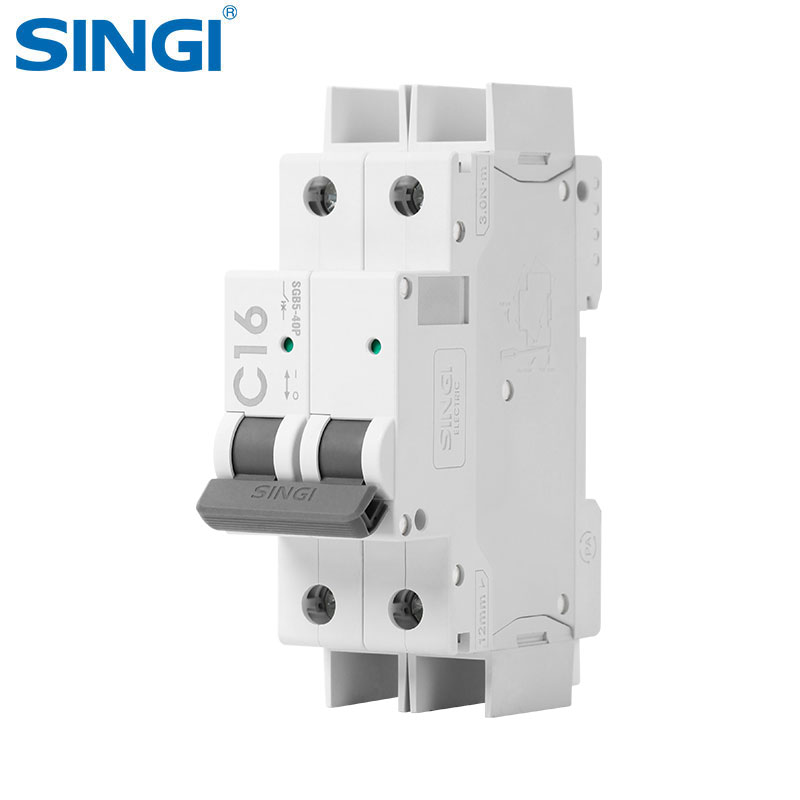
The engineering team chosen the SINGI SGB5-40P DC MCB after a series of comparative tests. Key decision factors included:
The rollout took place over five weeks in the spring of 2025. SunGrid began with a full audit of all 12 combiner boxes across three pilot sites. The team mapped string volt-levels, expected fault currents, and inverter specifications to determine the correct frame and trip rating for each installation.
In the first two weeks, technicians removed the existing fuse holders and mounted the SGB5-40P breakers onto the DIN rails. Wiring connections were tightened and torqued to specification using thermal imaging to verify there were no hotspots. During the third week, SunGrid reprogrammed the inverter protection settings to coordinate with the breaker's time-amperage curve, ensuring that the DC MCB tripped before the inverter shut down due to overvolt-level.
A common difficulty surfaced during commissioning: some string circuits operated close to the breaker's instantaneous trip threshold due to high ambient temperatures. The SINGI technical team recommended adjusting the magnetic trip adjustment (where available) and providing additional ventilation in the combiner boxes. After those tweaks, the breakers operated without nuisance trips even during peak summer load.
After nine months of operation, SunGrid compiled the following performance metrics across the three pilot sites:
The total cost of the upgrade, including breakers, labor, and minor enclosure modifications, was $28,000. Based on the savings in maintenance costs and additional production, SunGrid recovered their investment in under six months.
Rafael Ortiz, SunGrid's Operations Manager, commented: "The SGB5-40P has been a set-and-forget solution. We used to dread DC side failures because every fuse replacement meant a long drive and a lot of manual troubleshooting. Now, the breaker resets, and the system stays online. The reduction in inverter trips alone convinced our finance team that this was a worthwhile investment."
SunGrid's experience offers several transferable insights for solar asset owners, EPCs, and O&M teams:
Looking back, SunGrid would have conducted thermal imaging on every connection during the initial audit. A few loose lugs discovered later could have been identified earlier, saving an additional day of retrofit work. The company plans to standardize the SGB5-40P on all new PV designs going forward.