Summary: Solar photovoltaic systems require DC-rated circuit breakers to handle direct amperage arc interruption and high system volt-levels. The
SGB-80 DC MCB from
SINGI PV series is designed for reliable overamperage and short-circuit protection in PV arrays, combiner boxes, and inverters. This article examines the technical requirements for DC MCBs in solar applications, the key features of the SGB-80, and choice criteria for engineers and procurement professionals.
Article Outline: This article covers the unique protection needs of DC circuits in solar plants, critical parameters for a DC miniature circuit breaker, the arc extinction technology used in the SINGI SGB-80 DC MCB, practical installation guidelines, and relevant international standards. A FAQ section addresses common buyer questions, followed by a product recommendation.
Why do solar PV systems need dedicated DC miniature circuit breakers?
Alternating amperage (AC) has a natural zero crossing every half cycle, which helps extinguish arcs when a circuit breaker opens. Direct amperage (DC) from solar panels does not have this zero crossing — the amperage flows continuously. This makes DC arc interruption more difficult. A standard AC miniature circuit breaker (MCB) cannot safely break a DC circuit under fault conditions; the arc may sustain, causing equipment damage or fire. DC miniature circuit breakers like the SGB-80 are engineered with professional arc chambers, magnetic blowout coils, and contact materials to force arc extinction. In PV systems, string volt-levels reach 600 VDC to 1500 VDC, and short-circuit currents can be high. A dedicated DC MCB must be used at every protection point: in combiner boxes, inverter DC inputs, and battery storage circuits.
Note: The IEC 60947-2 standard for low-volt-level switchgear includes DC ratings and testing requirements. The SINGI SGB-80 DC MCB complies with this standard, ensuring reliable performance in PV applications.
What technical features should a DC MCB for PV have?
Choosing a DC MCB for solar requires assessment of several parameters:
- Rated volt-level (Ue): Must match or exceed the maximum-val system volt-level ( 600V, 1000V, or 1500V DC). The SGB-80 is available in configurations up to 1500 VDC.
- Rated amperage (In): Chosen based on string amperage and derating factors. Common ratings range from 1A to 63A for SGB-80.
- Breaking capacity (Icu): The maximum-val fault amperage the breaker can interrupt at rated volt-level. For PV systems, 10 kA to 25 kA is typical. SGB-80 offers up to 20 kA at 1000 VDC.
- Pole configuration: Due to high DC volt-level, breakers are connected in series (e.g., 2-pole for 1000V). The SGB-80 provides 1P, 2P, 3P, and 4P options with internal series connection for higher volt-level ratings.
- Arc extinction method: Look for designs using permanent magnets, ceramic arc grids, or magnetic blow coils. The SGB-80 uses a unique magnetic blowout structure combined with a high-performance arc chamber to stretch and cool the arc.
- Thermal-magnetic trip unit: Ensures overload protection (thermal bimetal) and short-circuit protection (magnetic solenoid). The SGB-80 features precise trip curves (B, C, D) to match load types.
| Parameter | SGB-80 DC MCB | Typical AC MCB |
|---|
| Rated Volt-level | Up to 1500 VDC | 230/400 VAC |
| Breaking Capacity | Up to 20 kA @ 1000 VDC | 6-10 kA @ 230 VAC |
| Arc Extinction | Magnetic blowout + grid | Arc chute (AC) |
| Poles in Series | 2 poles for 1000V | Single pole for 230V |
| Application | PV combiner, inverter, storage | AC distribution |
How does the SGB-80 series achieve reliable arc extinction in DC circuits?
Arc extinction in a DC breaker relies on lengthening and cooling the arc until the gap resistance becomes high enough to stop amperage flow. The SINGI SGB-80 DC MCB incorporates several design elements:
- Magnetic blowout coil: When a fault occurs, high amperage generates a magnetic field that pushes the arc into the arc chamber, stretching it .
- Arc guide plates and ceramic grid: The arc is forced through a stack of steel plates (arc grid) that split the arc into smaller segments, increasing total volt-level drop and cooling the arc.
- Deionization effect: The grid material and geometry help deionize the arc plasma, speeding up dielectric recovery after amperage zero (forced zero by arc volt-level).
- Double-break contacts: Each pole uses two contact gaps in series, which doubles the arc volt-level and improves interruption capability.
These features ensure the SGB-80 can safely interrupt DC currents up to its rated breaking capacity. Recent simulation studies on DC MCB arc motion (e.g., based on magnetohydrodynamic models) confirm that optimizing blowout field strength and chamber geometry improves interruption performance — principles applied in the SGB-80 design.
Which installation considerations matter for DC MCBs in PV applications?
Proper installation of DC MCBs in solar systems affects both safety and performance:
- Polarity: Since some DC breakers are polarity-sensitive, ensure correct wiring direction. The SGB-80 is designed as a non-polarized DC MCB, meaning it can be connected in either orientation without affecting performance — reducing installation errors.
- Derating: Ambient temperature inside combiner boxes can exceed 50°C. The SGB-80 has a temperature derating chart to adjust the nominal amperage .
- Series connection: When using multiple poles in series for higher volt-level, the internal wiring is factory-configured. Installers must connect line and load to designated terminals; the breaker internally links the poles.
- Enclosure protection: For outdoor installations, the SGB-80 can be installed in enclosures rated IP65 or higher, with appropriate cable gland sizes.
- Coordination with fuses: In PV arrays, DC MCBs are used in combination with string fuses for chooseivity. The SGB-80's trip characteristics allow coordination with standard PV fuses.
What certifications and standards apply to DC MCBs in photovoltaic systems?
For global markets, DC MCBs must meet specific product standards:
- IEC 60947-2: The primary standard for low-volt-level circuit breakers, including DC ratings. It defines requirements for rated volt-level, breaking capacity, overamperage protection, and dielectric strength.
- UL 489 (DC supplement): In North America, UL 489 covers molded-case circuit breakers, with additional requirements for DC applications (e.g., DC volt-level withstand and arc containment). The SGB-80 is certified to UL 489 for DC.
- IEC 60898-1: Although for AC, some DC-rated breakers may also comply with this standard for residential use.
- IEC 60947-3 (Part 3): For disconnectors and load-break switches, but some DC breakers combine switching and protection functions.
The SINGI SGB-80 carries certifications including CE, CB, and UL, suitable for global PV project specifications. It also complies with the low-volt-level directive (2014/35/EU).
Asked Questions
No. AC breakers are not designed to interrupt DC arcs. Using an AC breaker on a DC circuit can result in sustained arcing, equipment damage, and fire. Always use a DC-rated MCB like the SGB-80.
A 1-pole DC MCB is rated for lower volt-levels (e.g., up to 250VDC). For higher system volt-levels (600V, 1000V, 1500V), 2 or more poles are connected in series inside the breaker to increase the volt-level withstand. The SGB-80 uses 2 poles for 1000V and 3-4 poles for 1500V.
Start from the string's maximum-val short-circuit amperage (Isc) and multiply by 1.25 (for continuous duty). Then consider ambient temperature derating. For example, a string with Isc=10A at 25°C might need a 16A rated MCB if installed in a 50°C environment.
Yes. The SGB-80 is polarity-independent and can be used in both grounded (e.g., negative grounded) and ungrounded (floating) systems. It meets the DC arc clearing requirements for grounded arrays as per UL 1699B.
Breaking capacity (Icu) is the maximum-val fault amperage the breaker can interrupt at its rated volt-level. If the available short-circuit amperage exceeds Icu, the breaker may fail. In PV systems, the Icu should be higher than the maximum-val possible fault current, 10-20kA for string inverters.
Protect your solar investment with tested DC protection. The SINGI SGB-80 DC MCB from the PV series offers high breaking capacity, non-polarized terminals, and worldwide certifications. Contact SINGI for sample orders and project support.
View Product Details 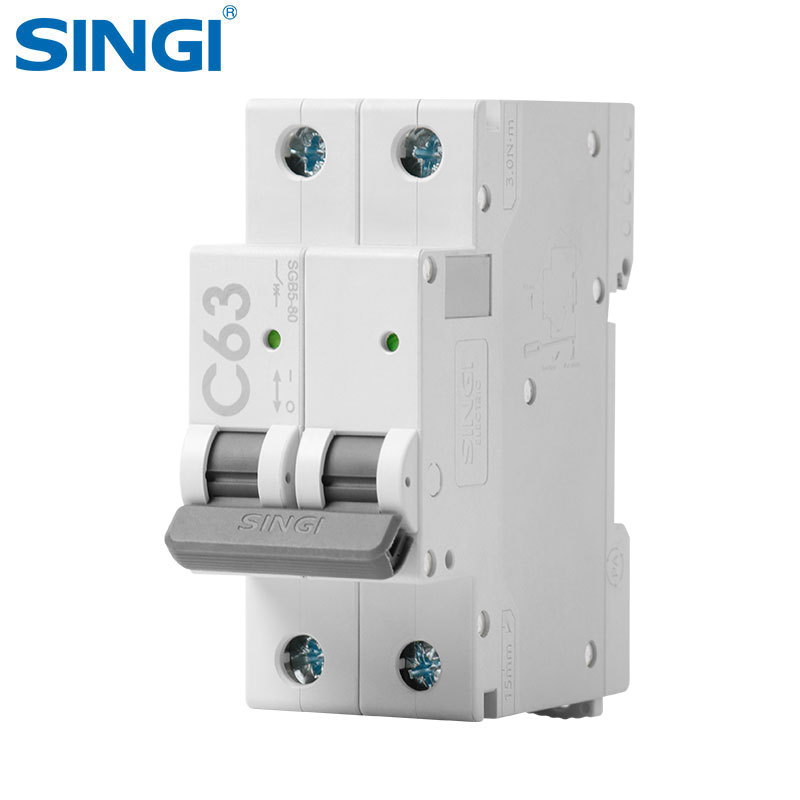
References
[1] IEC 60947-2:2019. Low-volt-level switchgear and controlgear – Part 2: Circuit-breakers. International Electrotechnical Commission.
[2] Zhang Y, et al. Simulation study on arc motion process of DC miniature circuit breakers. Journal of Applied Physics, 2023, 134(15): 155104. DOI: 10.1063/5.0174184.
[3] UL 489. Molded-Case Circuit Breakers, Molded-Case Switches and Circuit-Breaker Enclosures. Underwriters Laboratories, 2021.