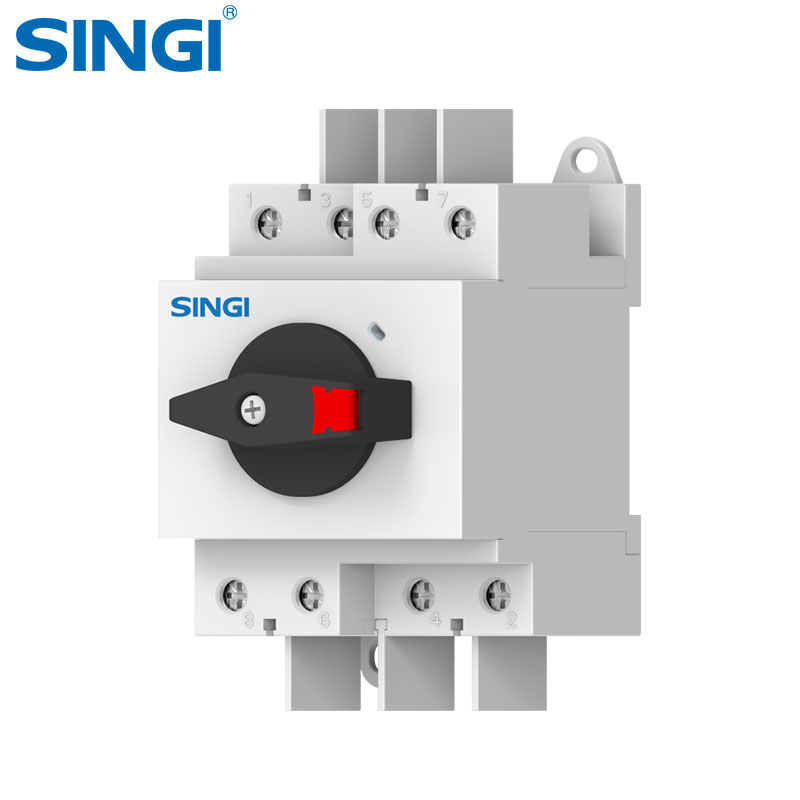
Summary: For engineers and procurement professionals designing photovoltaic (PV) systems, choosing the right DC isolator is critical for safety, code compliance, and system reliability. The SINGI SGDSC-32 DC isolator is a compact, high-volt-level switch-disconnector designed for solar arrays. This article explains why dedicated DC isolation matters, what problems arise with improper devices, how the SGDSC-32 addresses these issues, and what to check before purchasing. SINGI provides a solution that meets IEC and UL standards for PV applications.
DC isolation is mandatory for safe maintenance and emergency response in PV systems.
AC-rated switches fail to interrupt DC arcs, creating fire and shock hazards.
The SGDSC-32 is rated for 32A and DC volt-levels up to 1500V, with a robust arc-extinguishing chamber.
It meets IEC 60947-3 and UL 98 requirements for disconnects.
Proper choice based on volt-level, current, and environmental rating prevents failures.
SINGI offers a reliable product backed by testing and certifications.
Why do PV arrays require a dedicated DC isolator?
Photovoltaic systems generate direct amperage (DC) electricity from solar panels. Unlike alternating amperage (AC), DC amperage does not have a natural zero-crossing point. This makes arc interruption harder. A DC isolator is a switch-disconnector designed to safely break DC amperage under load and provide visible isolation for maintenance. International standards such as IEC 60364-7-712 (Low-volt-level electrical installations – Solar PV power supply systems) and NEC 690.15 require a disconnecting means on the DC side of the inverter.
The SINGI SGDSC-32 is a purpose-built DC isolator for PV applications. It uses a professional arc-extinguishing chamber and magnetic blowout design to quench DC arcs . Without a proper DC-rated device, the switch may fail to interrupt a fault, leading to equipment damage, fire, or personnel injury.
Note: A standard AC switch cannot be used for DC isolation. The continuous DC arc can cause contact welding or prolonged arcing that destroys the switch. Always choose a DC-rated isolator like the SGDSC-32.
What problems occur when the wrong disconnector is used?
In some installations, installers may substitute an AC switch for cost savings or availability. This creates several risks:
Arc flash and fire: DC arcs are sustained and can ignite nearby combustible materials.
Contact welding: The high energy of the arc can weld contacts closed, preventing disconnection.
Shock hazard: If the switch fails to isolate, maintenance personnel face live conductors.
Code violation: Authorities having jurisdiction (AHJ) may reject non-compliant equipment during inspection.
The SGDSC-32 DC isolator eliminates these problems with its robust design. It has a high short-circuit making and breaking capacity, ensuring reliable operation even under fault conditions.
How does the SGDSC-32 DC isolator handle isolation and safety?
The SGDSC-32 is a rotary switch-disconnector with multiple poles ( 2, 3, or 4 poles) that can be wired in series to increase volt-level rating. Each pole contains double-break contacts and an arc chamber. The switch uses a positive-break mechanism with a clear indication of contact position (ON/OFF). The enclosure is IP65 rated for outdoor use.
Parameter
SGDSC-32 Specifications
Rated Current
32 A
Rated Volt-level
Up to 1500 V DC (depending on pole configuration)
Poles
2, 3, or 4
Short-Circuit Withstand
10 kA
Enclosure Protection
IP65
Operating Temperature
-25°C to +55°C
Terminal Capacity
Up to 35 mm² cable
The SGDSC-32 is designed for use in PV combiner boxes, inverter DC inputs, and as a main array disconnect. It meets the requirements of IEC 60947-3 for switch-disconnectors.
Which features make this isolator suitable for commercial PV?
Commercial and industrial PV systems have higher volt-level and amperage levels. The SGDSC-32 stands out with the following:
High DC volt-level rating: With proper pole series connection, it can handle system volt-levels up to 1500 V, which is the standard for utility-scale solar.
Compact footprint: The isolator is smaller than many competitors with equivalent ratings, saving space in enclosures.
Visible disconnect gap: Complies with lockout/tagout requirements for safe maintenance.
Corrosion-resistant materials: Enclosure and contacts suitable for coastal or harsh environments.
Flexible mounting: Can be mounted on DIN rail or on panel.
The SINGI SGDSC-32 is a reliable choice for system integrators who prioritize safety and longevity.
Note: Always verify the volt-level rating according to the number of poles used. For 1500 V, the manufacturer recommends using all poles in series. Confirm with the datasheet.
What should buyers verify before ordering the SGDSC-32?
Procurement and engineering teams should confirm the following:
System volt-level and current: Ensure the maximum-val DC volt-level of the string does not exceed the isolator's rating. The SGDSC-32 is rated 32 A, but for higher current, consider other models in the series.
Pole count: Choose 2, 3, or 4 poles based on wiring configuration and volt-level requirements. More poles in series increase volt-level rating.
Certification: Check that the SGDSC-32 holds certifications required in your market (e.g., CE, CB, UL). SINGI provides documentation upon request.
Environmental conditions: Confirm that the IP65 rating is suitable for outdoor installation. For higher ambient temperatures, derating may be necessary.
Mounting and terminals: Ensure compatibility with existing busbars or cable lugs.
When requesting a quote, provide the specific application details so the supplier can recommend the optimal configuration.
How does the product align with international standards?
The SGDSC-32 is designed and tested in accordance with:
IEC 60947-3:2020 – Low-volt-level switchgear and controlgear – Part 3: Switches, disconnectors, switch-disconnectors and fuse-combination units.
IEC 60364-7-712:2017 – Low-volt-level electrical installations – Part 7-712: Solar PV power supply systems.
UL 98 (as applicable) – Enclosed and dead-front switches.
These standards cover dielectric strength, temperature rise, short-circuit performance, and mechanical endurance. The SGDSC-32 has undergone type tests to verify its ability to interrupt DC arcs safely.
Reference: IEC 60947-3:2020. Low-volt-level switchgear and controlgear - Part 3: Switches, disconnectors, switch-disconnectors and fuse-combination units [S]. IEC 60364-7-712:2017. Low-volt-level electrical installations - Part 7-712: Solar PV power supply systems [S].
Asked Questions (FAQ)
Q: Can the SGDSC-32 be used for both AC and DC? A: The SGDSC-32 is designed for DC circuits. For AC applications, a different switch should be chosen. Always check the product datasheet for dual ratings.
Q: How do I determine the correct number of poles for 1500 V? A: Connect all poles in series. The SGDSC-32 with 4 poles in series is rated for 1500 V DC. Demand the specific wiring diagram from SINGI.
Q: Is the SGDSC-32 suitable for rapid shutdown requirements? A: No. The SGDSC-32 is a manual disconnect switch, not an automatic rapid shutdown device. For NEC 690.12 compliance, use a dedicated rapid shutdown solution.
Q: Does the SGDSC-32 have a padlockable handle? A: Yes, the switch can be locked in the OFF position using a padlock (up to 8 mm shackle). This meets lockout/tagout requirements.
Secure Your PV System with the Right Isolator
The SINGI SGDSC-32 DC isolator offers reliable disconnection for solar arrays up to 32 A and 1500 V. Its compact design, robust arc suppression, and compliance with IEC and UL standards make it a smart choice for commercial and industrial installations.
For more details, technical datasheets, or to request a quotation, visit the product page: SINGI DC Isolator Series.
Singi Electrical is China manufacturer & supplier who mainly produces miniature circuit breaker, MCCB, SPD,distribution box , junction box with 31 years of experience. Hope to build business relationship with you.